See All

Psynth vs. Mentalyc: Therapy Notes Tool or Report-Writing Tool?
Psynth vs. Mentalyc: Mentalyc writes therapy notes and treatment plans. Psynth drafts psychological assessment reports. Here's which fits you.
Author

Reviewed By

Share This
Choose Mentalyc if you're a therapist who needs AI progress notes, treatment plans, and session insights for a weekly caseload. Choose Psynth if you're a psychologist whose main work is assessment, and what you need drafted is the full psychological evaluation report, not the session note.
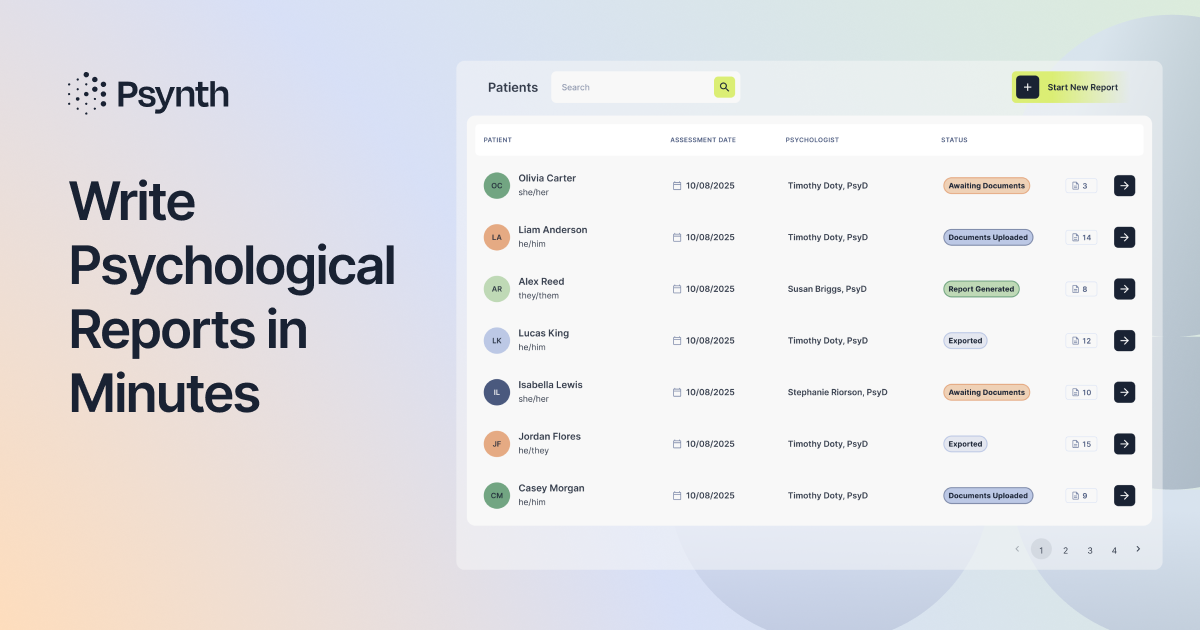
The two get compared because both use AI to take documentation off a clinician's plate, and both list psychologists among their users. But they're built around different documents. Mentalyc is a notes tool: it turns a session into a SOAP, DAP, or BIRP note and tracks progress across sessions. Psynth is a report tool: it turns a battery of test scores and records into a draft evaluation report. If you're searching for a Mentalyc alternative, the first question is which of those two documents you actually need help with.
What is Mentalyc?
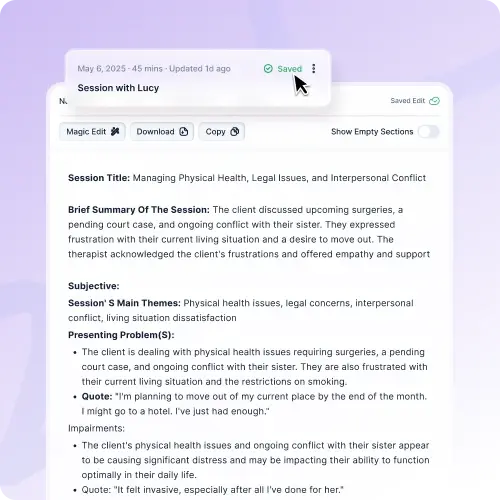
Mentalyc is an AI note-taking and clinical documentation tool for therapists, counselors, and other mental health professionals. It records or receives session content, then drafts progress notes, treatment plans, and progress summaries, and it offers session analytics, including a therapeutic alliance score it calls Alliance Genie.
Here is what Mentalyc publishes, as of October 2026 (Mentalyc):
- Note formats: SOAP, DAP, BIRP, GIRP, PIE, intake notes, MSE, biopsychosocial assessments, supervision notes, and treatment plans.
- Capture: record in-person or telehealth sessions, upload audio, dictate a recap, or type a summary.
- Clinical tools: an AI treatment planner, a progress tracker, and Alliance Genie, which Mentalyc describes as alliance scores "derived from session content, not from a client questionnaire."
- EHR: Mentalyc says it works with EHRs such as SimplePractice, TherapyNotes, and Jane App.
- Security: Mentalyc states it is HIPAA, PHIPA, and SOC 2 compliant, offers a BAA, and deletes session audio "once your note is ready."
- For psychologists: Mentalyc says "Psychologists use Mentalyc for testing summaries, progress tracking, and cross-session analytics."
That last line matters for this comparison. Mentalyc does support psychologists, and a testing summary is a useful document. It's a different job from drafting a complete evaluation report built on a multi-measure battery.
What is Psynth?
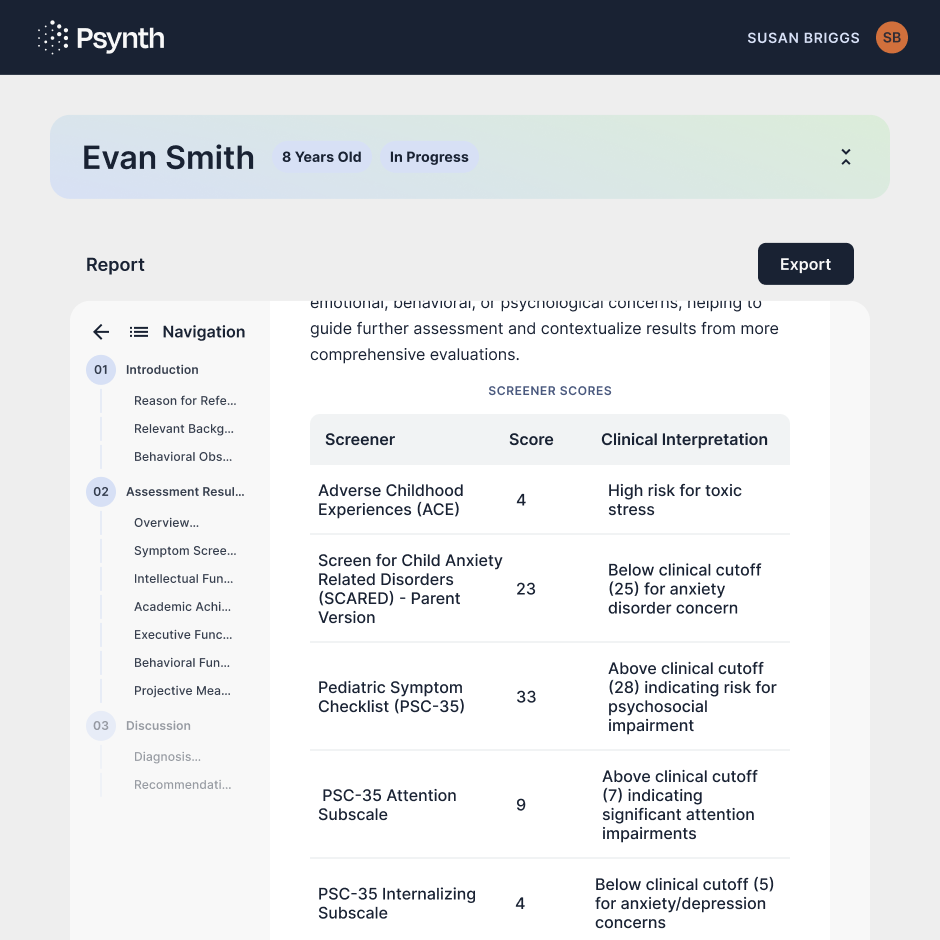
Psynth is purpose-built for the psychological assessment report. You bring the evaluation data (test scores, PDFs, records, handwritten notes), and Psynth produces a PhD-smart first draft for you to review, edit, and sign. The psychologist interprets and diagnoses; Psynth organizes the data and drafts the language.
What that looks like in practice:
- 450+ supported assessments, so measures like the WISC-V, BASC-3, and Vineland are recognized by name.
- Test-by-test format, which keeps PHI from one report out of another.
- No AI data retention: Psynth's AI vendors retain no data, and patient data is never used to train models.
- Compliance: HIPAA, PIPEDA, GDPR, SOC 2 Type 2, and ISO 27001, third-party verified by Assured Information Solutions (AIS).
- Ambient listening for assessment sessions, so intake interviews and feedback sessions can be captured alongside the report. We wrote about how that capture should behave in our post on ambient listening for psychologists.
The full list is on Psynth's features page.
Psynth vs. Mentalyc at a glance
Every competitor detail below comes from Mentalyc's own site. Competitor details verified from public sources as of October 2026; features change.
Where Mentalyc is the better fit
For many clinicians, Mentalyc is the right call. Here's where it has the edge.
You see clients every week. A therapist with a full caseload writes dozens of progress notes a week. Mentalyc is built to make that note fast, in the format your payer or supervisor expects, and to support group, couples, family, and child modalities on its higher plans (Mentalyc Pricing).
You want insight across sessions. Progress tracking and alliance scores are designed for ongoing treatment, where the question is how a client is changing over months. Psynth isn't built for that.
You want to keep your EHR and add notes. Mentalyc says it works with SimplePractice, TherapyNotes, and Jane App, so it can slot into a therapy workflow you already have.
You want a low monthly entry point. Mentalyc's solo plans are priced by monthly note volume, which is easy to size to a caseload.
Where Psynth is the better fit
The balance shifts when evaluations, not sessions, are the core of the practice.
The report is your product. A psychological evaluation integrates a battery of measures, records, observations, and history into one narrative with a diagnosis and recommendations. That's a longer, higher-stakes document than a session note, and it's the one Psynth drafts. Dr. Lexie Molina, who runs a solo psychoeducational practice, went from 3 to 4 hours per report to about 15 minutes for a first draft. She hasn't worked a weekend since.
You're integrating many data points. Dr. Edgington, who handles complex evaluations, described Psynth as an intelligent workspace that organizes the "puzzle pieces," which reduced the mental load of switching between systems.
You need capacity without hiring. Dr. Taylor Fladhammer's high-volume practice saw a 2 to 3x increase in assessment capacity and a 4x improvement in report speed. For families on a waitlist, that turnaround is the difference.
You want the report and the session capture in one place. With ambient listening in the same workspace as the report, the intake interview and the test data end up in one place instead of two tools.
What about psychologists who do both?
Plenty of psychologists carry a therapy caseload and run evaluations. For them, this isn't either/or. A notes tool handles the weekly sessions; a report tool handles the evaluations. The mistake is expecting one to do the other's job well. A tool designed for session notes won't be organized around a WISC-V, a BASC-3, and a stack of school records, and a report tool isn't designed to track therapeutic alliance across 30 sessions.
If you're also sorting out how you document therapy sessions, our guide to psychologist notes covers formats and what to include.
Who should choose which
Choose Mentalyc if:
- Most of your hours are recurring therapy sessions
- You need SOAP, DAP, or BIRP notes every day
- You want treatment plans and progress tracking drafted from sessions
- You value session analytics like alliance scores
- You want a notes tool that sits next to SimplePractice, TherapyNotes, or Jane App
Choose Psynth if:
- Psychological, psychoeducational, or neuropsychological evaluations are your core work
- Your backlog is full of reports, not session notes
- You integrate multi-measure batteries and records into one narrative
- You want intake and feedback sessions captured next to the report
- You need AI vendors that retain no data and a full compliance stack for assessment data
Comparing report tools instead? See Psynth vs. Reverb Reports.
See a report come together
If evaluations are the center of your week, judge Psynth on the document that matters to you. Book a demo and bring a de-identified case from your usual battery.
Frequently Asked Questions
What is Mentalyc used for?
Mentalyc drafts therapy documentation. It turns recorded, uploaded, dictated, or typed session content into progress notes (SOAP, DAP, BIRP, and others), treatment plans, and progress summaries, and it adds session analytics such as alliance scores, per mentalyc.com as of October 2026.
Can Mentalyc write a psychological evaluation report?
Mentalyc's site says psychologists use it for "testing summaries." It does not describe drafting full psychological evaluation reports from standardized test scores and records. If a complete report is what you need, test any tool on a real case first.
Is Psynth a Mentalyc alternative?
Only if your main need is assessment reports. Psynth doesn't write therapy progress notes or track alliance across sessions. For psychologists whose core work is testing, Psynth covers the document Mentalyc isn't built around.
How much does Mentalyc cost?
Mentalyc's solo plans start at $19.99 per month ($14.99 per month billed annually) for 40 notes and go up to $119.99 per month for 330 notes, with per-seat team plans, per its pricing page as of October 2026. Prices change, so check the current page.
Is Mentalyc HIPAA compliant?
Mentalyc states it is HIPAA, PHIPA, and SOC 2 compliant and signs a BAA, per its website as of October 2026. Psynth is HIPAA, PIPEDA, GDPR, SOC 2 Type 2, and ISO 27001 compliant, and its AI vendors retain no data.
Does Psynth record sessions?
Psynth includes ambient listening for assessment sessions, such as intake interviews and feedback sessions. Clinicians stay responsible for consent and for reviewing every draft.
See Psynth work in real time
We’ll demo an end-to-end report writing process and answer any questions along the way. (Yes, it’s so quick, we can get through it all during a single call.)