Psynth vs. Blueprint: Which One Fits an Assessment Practice?
Psynth vs. Blueprint AI: Blueprint is built for therapy notes and practice work. Psynth drafts psychological assessment reports. See which fits.


If most of your week is ongoing therapy sessions and you want AI notes, treatment plans, and practice tools in one place, Blueprint is the better fit. If your practice runs on psychological assessment and the bottleneck is turning test scores, records, and interview data into a finished evaluation report, Psynth is built for that job.
Both tools use AI to cut documentation time, and psychologists use both. The difference is the document each one is designed to produce. Blueprint AI is organized around the therapy session and the progress note. Psynth is organized around the assessment battery and the report. This post lays out what each product does, based on Blueprint's public pages and Psynth's own, so you can match the tool to the work you actually do.
What is Blueprint AI used for?
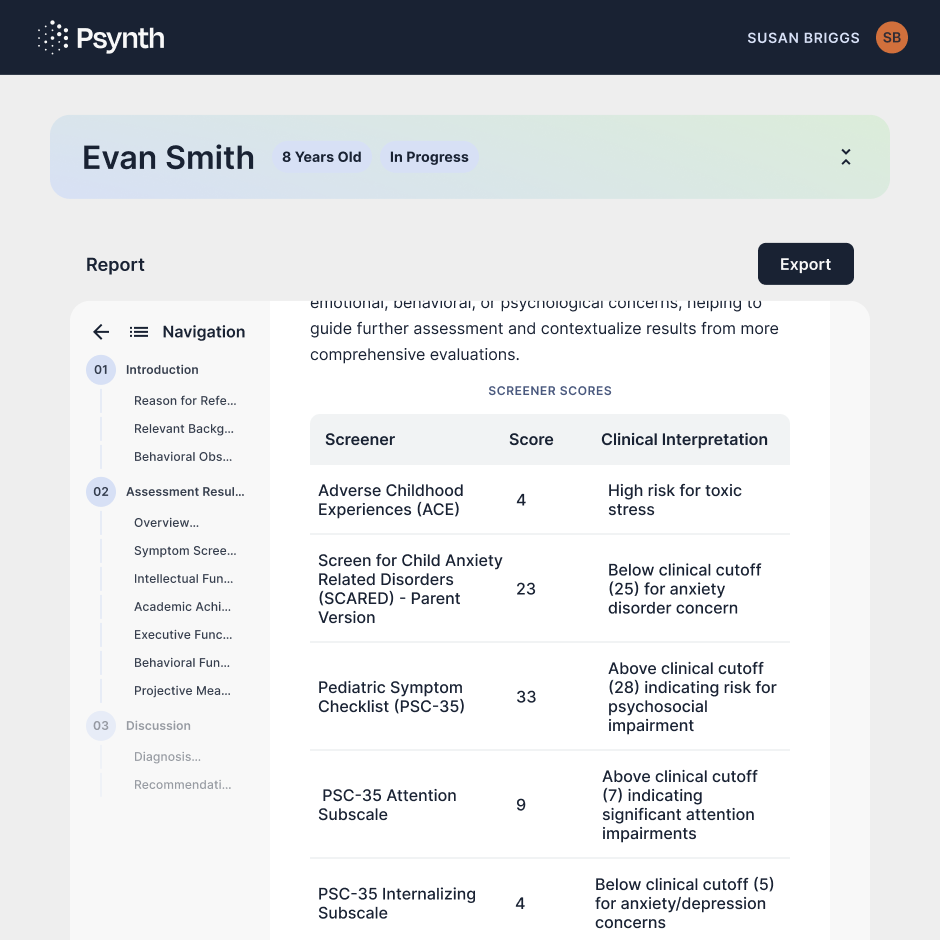
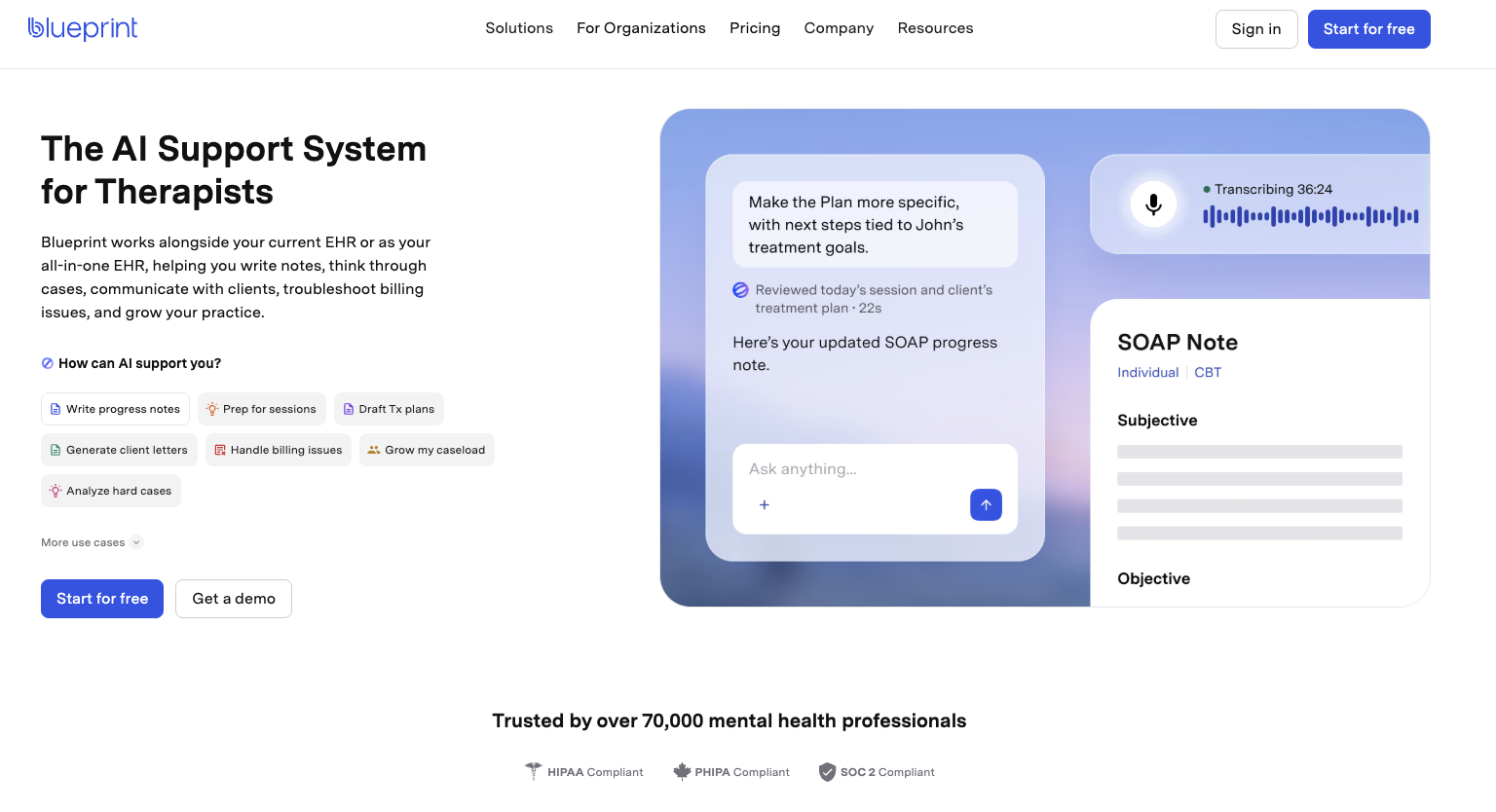
Blueprint describes itself as "the AI support system for therapists." It drafts progress notes from a live session, dictation, an uploaded recording, or a few typed lines, and it also drafts treatment plans, client letters, discharge summaries, and biopsychosocial assessments. Practices can use it alongside their current EHR or run their whole practice inside Blueprint's all-in-one EHR.
A few details from Blueprint's site, as of October 2026:
- Note formats: SOAP, DAP, BIRP, GIRP, EMDR, intake notes, psychiatric evaluations, or a custom template (Blueprint AI Documentation).
- Letters: referral, court, school, termination, accommodation, and medical necessity letters (Blueprint Pricing).
- Clinical support: session prep, progress against treatment plan goals, and a library of "600+ assessments and worksheets" (Blueprint AI Clinical Support).
- Practice operations: billing and insurance support, client communications, and marketing support, plus scheduling, telehealth, intake forms, and a client portal on the all-in-one plan (Blueprint Pricing).
- Audio: Blueprint states that audio is "permanently deleted after transcription" (Blueprint AI Documentation).
That is a broad toolkit for a therapy caseload. It covers the notes, the plan, the letters, and the billing that come with seeing clients every week.
What Psynth is built for
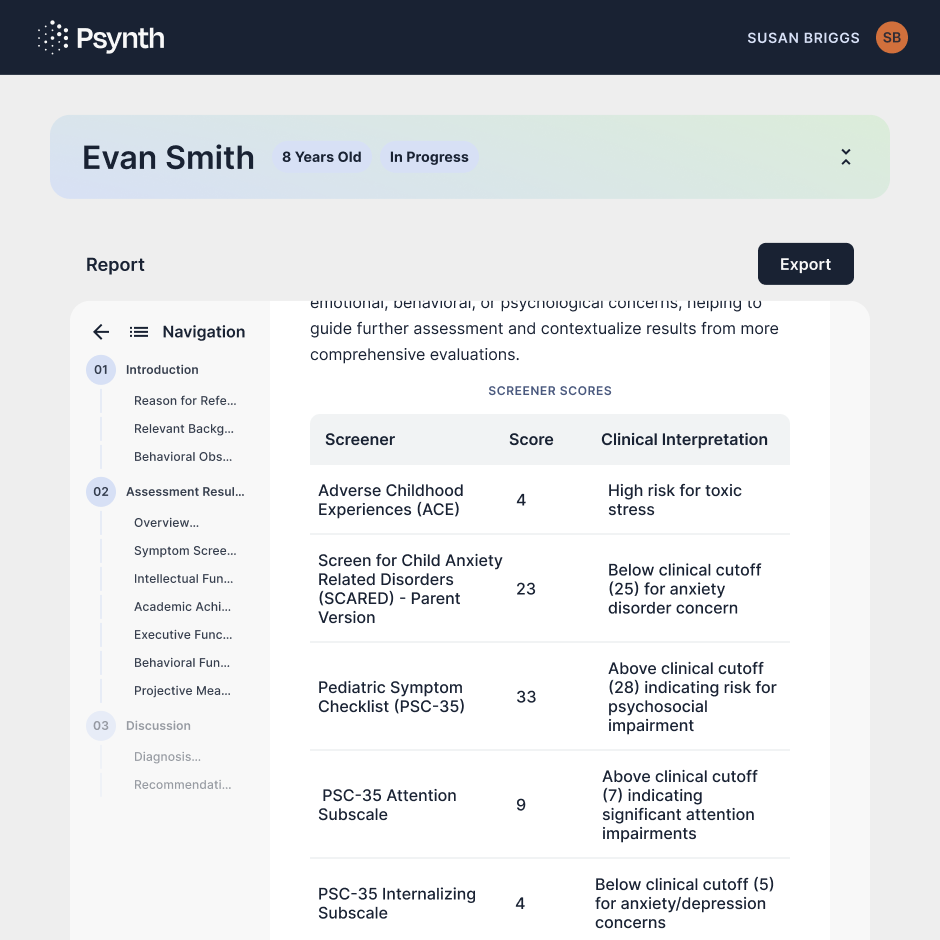
Psynth is purpose-built for one workflow: the psychological assessment report. You bring the raw material of an evaluation (test scores, PDFs, records, handwritten notes), and Psynth produces a PhD-smart first draft that you review, edit, and sign. The psychologist interprets and diagnoses. Psynth organizes the data and drafts the language.
That focus shows up in how Psynth is built:
- Assessment library: 450+ supported assessments, so instruments like the WISC-V, BASC-3, and Vineland are handled by name, not as generic uploads.
- Test-by-test format: each measure is handled on its own, which keeps PHI from one report out of another.
- No AI data retention: Psynth's AI vendors retain no data, and patient data is never used to train models.
- Compliance: HIPAA, PIPEDA, GDPR, SOC 2 Type 2, and ISO 27001, third-party verified by Assured Information Solutions (AIS). Details are on Psynth's security page and at trust.psynth.ai.
- Ambient listening: Psynth includes ambient listening for assessment sessions, so intake interviews and feedback sessions can be captured and turned into editable drafts inside the same workspace as the report.
You can see the full list on Psynth's features page.
Psynth vs. Blueprint at a glance
The table below uses only facts published on each company's own site. Competitor details verified from public sources as of October 2026; features change.
Where Blueprint is the better fit
Blueprint makes more sense for many clinicians, and it is worth saying plainly.
You mostly do therapy. If your week is 25 or 30 recurring sessions, the document you write most often is a progress note. Blueprint is designed around that note, in the format you already use, and around the treatment plan it feeds.
You want one system for the practice. Blueprint's all-in-one plan puts scheduling, telehealth, intake forms, a client portal, and insurance billing alongside AI documentation. Psynth does not do any of that. If you are looking to replace your EHR, Psynth is not the tool.
You like pay-per-session pricing. Blueprint prices by session with no subscription on its per-session plans, which suits a caseload that rises and falls.
You track outcomes between sessions. The client-facing library of assessments and worksheets, and the questions Blueprint suggests asking ("How have Jordan's assessment scores changed since intake?"), point to measurement-based therapy, not diagnostic testing.
Where Psynth is the better fit
The picture changes when your work centers on evaluations rather than sessions.
Your bottleneck is the report, not the note. A comprehensive evaluation means integrating a battery of measures, records, and interview data into a single, defensible narrative. That is the document Psynth drafts. Dr. Lexie Molina, a solo practitioner doing psychoeducational assessments, went from 3 to 4 hours per report to about 15 minutes for a first draft, and she hasn't worked a weekend since.
You run complex batteries. Dr. Edgington described Psynth as an intelligent workspace that organizes the "puzzle pieces" of a complex evaluation, which cuts the mental strain of juggling separate systems. For neuropsychologists and anyone scoring a long battery, that organization is the point.
You want more evaluations without more hours. Dr. Taylor Fladhammer's high-volume practice saw a 2- to 3x increase in assessment capacity and a 4x improvement in report speed. Shorter turnaround means shorter waitlists for families.
Your compliance bar is high. AI vendors that retain no data and a test-by-test format are built for the data that assessment reports carry. Our earlier piece on AI psychology apps covers what to check in any vendor's data handling.
Can a practice use both?
Yes. Blueprint and Psynth are separate products that do different jobs. A group practice with therapists carrying weekly caseloads and psychologists running evaluations could use a notes tool for the first group and a report tool for the second. The intake overlap is real: Blueprint drafts biopsychosocial assessments, and the psychosocial assessment is often where an evaluation starts. The question is which document eats most of your time.
Who should choose which
Choose Blueprint if:
- Most of your clinical hours are ongoing therapy sessions
- You write progress notes and treatment plans every day
- You want AI tied to scheduling, telehealth, and insurance billing
- You want per-session pricing that follows your caseload
- You use between-session worksheets and client measures
Choose Psynth if:
- Most of your revenue comes from psychological or psychoeducational evaluations
- Your backlog is reports, not notes
- You integrate multi-measure batteries like the WISC-V, BASC-3, or Vineland
- You want intake and feedback sessions captured next to the report you're writing
- You need AI vendors that retain no data and a full compliance stack for assessment data
If you're weighing Psynth against other report tools rather than a notes platform, our comparison of Psynth and Reverb Reports covers that decision.
See how Psynth handles a real evaluation
If your week is built around testing, the fastest way to judge fit is to watch a report come together from your own kind of battery. Book a demo and bring a de-identified case.
Frequently Asked Questions
What is Blueprint AI?
Blueprint is an AI documentation and practice platform for therapists. It drafts progress notes, treatment plans, and client letters from recorded, dictated, or typed session content, and can run alongside an existing EHR or as an all-in-one EHR, per blueprint.ai as of October 2026.
Can Blueprint write a psychological evaluation report?
Blueprint's site lists psychiatric evaluations, intake notes, and biopsychosocial assessments among its formats. It does not describe drafting full psychological testing reports from standardized test scores. If that is your main document, test it on a real case before committing.
Is Psynth an EHR?
No. Psynth is a report-writing workspace for psychological assessment. It doesn't handle scheduling, billing, or a client portal. It is designed to sit next to the EHR you already use.