See All

Psynth vs. NeuroAide: Neuropsych Report Writing Compared
Psynth vs. NeuroAide for neuropsychological report writing: what each tool does, what NeuroAide publishes, and which fits your practice.
Author

Reviewed By

Share This
Psynth vs. NeuroAide: Neuropsych Report Writing Compared
Psynth and NeuroAide are both AI tools that draft neuropsychological and psychoeducational evaluation reports from test scores and clinical notes, and the clinician reviews and signs the result. The main differences are what each publishes about supported measures, how it produces the draft, and how you can evaluate each one.
This comparison covers only what both companies say publicly. NeuroAide's details come from its own website as of November 2026, and each is linked. Where NeuroAide does not publish something, we say so instead of guessing.

What is NeuroAide?
NeuroAide (neuroaide.ai) describes itself as an AI report assistant for neuropsychological and psychoeducational report writing. Here is what it publishes, as of November 2026:
- Who it is for: neuropsychologists and psychoeducational evaluators (NeuroAide home).
- How it drafts: it "learns your writing style, formatting, and conventions from past reports," then produces a complete draft in your structure and template, including your logos, fonts, and headers (NeuroAide how it works; NeuroAide FAQ).
- Inputs: test scores, questionnaire and intake data, evaluation notes, and supporting documents (NeuroAide product).
- Supported tests: its FAQ says it supports inputs from "hundreds of widely used assessment tools." It does not publish a full list or a specific count on the pages we reviewed (NeuroAide FAQ).
- Security: it states it is HIPAA-compliant with independent third-party attestation, and that BAAs are a standard part of its service. It lists encryption in transit and at rest, audit logging, and access controls (NeuroAide FAQ; NeuroAide home).
- Availability: US and Canada (NeuroAide FAQ).
- Trial: its trial page says you fill out a form and schedule a demo, after which it sets up a free trial account (NeuroAide trial).
NeuroAide does not publish pricing, trial length, data-retention terms, or SOC 2 status on the pages we reviewed. If any of those matter to you, ask them directly.
What is Psynth?
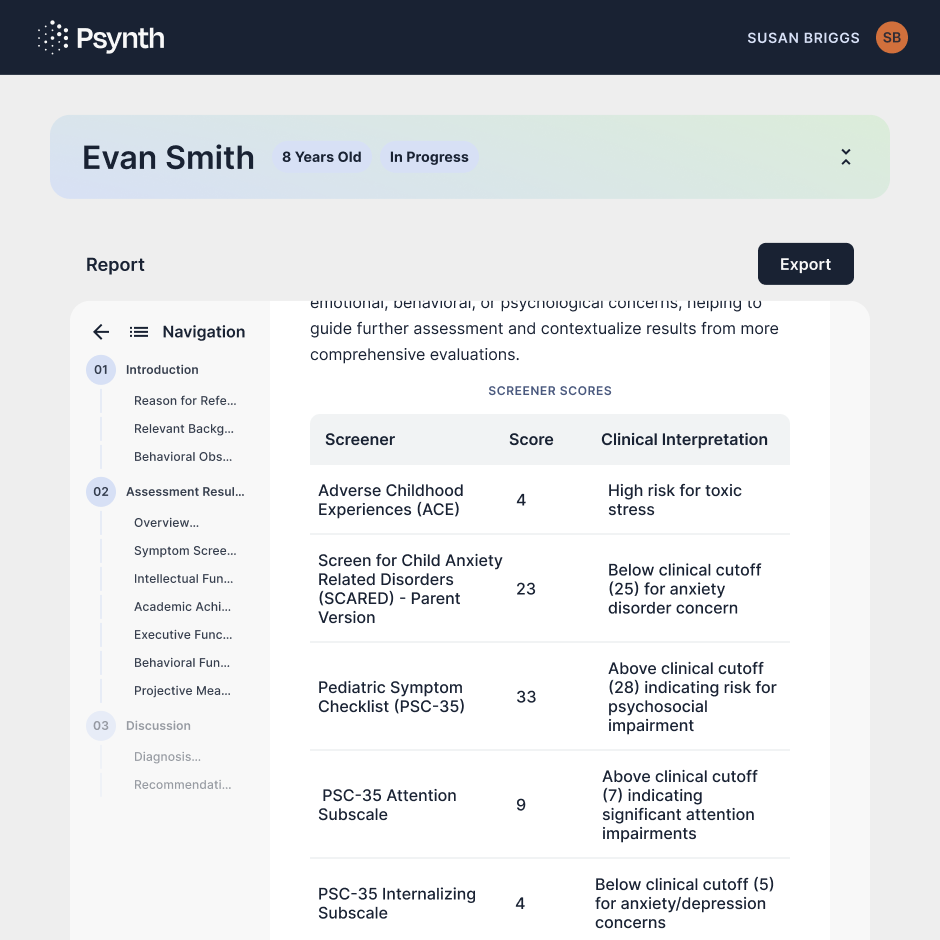
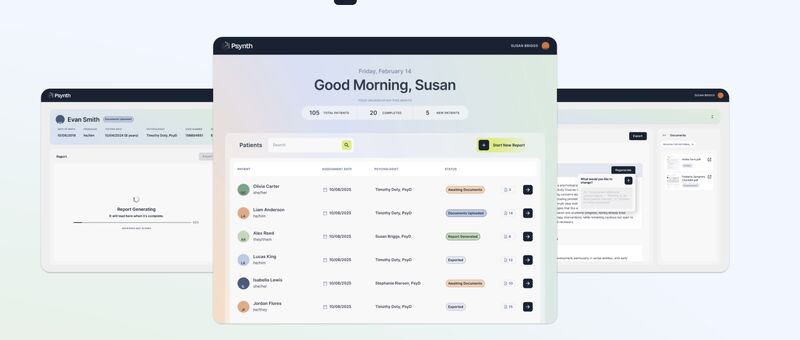
Psynth is built for the psychological assessment report. You bring the evaluation data (test scores, PDFs, records, handwritten notes), and Psynth produces a first draft for you to review, edit, and sign. The psychologist interprets and diagnoses; Psynth organizes the data and drafts the language.
- 450+ supported assessments, so measures are recognized by name.
- No AI data retention: Psynth's AI vendors retain no data, and patient data is never used to train models.
- Compliance: HIPAA, PIPEDA, GDPR, and SOC 2 Type 2, with a BAA available on every plan.
- Ambient listening is available as a paid add-on to capture intake and feedback sessions alongside the report.
- Time saved: Psynth's own claim is 6+ hours to under 45 minutes per report.
Psynth's Neuro vertical page covers neuropsychological workflows in more detail. For the difference between the two kinds of evaluation, see our explainer on neuropsychological vs. psychological testing.
Psynth vs. NeuroAide at a glance
NeuroAide details are from neuroaide.ai as of November 2026. Features change.
Where NeuroAide may fit
- You want the tool to mirror your past reports. NeuroAide's central pitch is style and template learning. If your reports follow a distinctive house structure, it's worth testing against a few of your own.
- Your work is mainly neuropsychological and psychoeducational. NeuroAide is positioned specifically for those two report types.
- You want to see it before pricing. Its trial starts with a demo, which suits clinicians who prefer a guided walkthrough first.
Where Psynth may fit
- You want a published measure count. Psynth supports 450+ assessments. If you use a less common battery, check any tool's coverage against your own measures before committing.
- You need session capture in the same workspace. Psynth offers ambient listening as an add-on so that the intake interview can sit beside the scores.
- You want the security details in writing. Psynth states no AI data retention, SOC 2 Type 2, and a BAA on every plan.
- Volume is the constraint. Dr. Taylor Fladhammer's high-volume practice saw a 2 to 3x increase in assessment capacity and a 4x improvement in report speed. Dr. Lexie Molina, who runs a solo psychoeducational practice, went from 3 to 4 hours per report to about 15 minutes for a first draft.
Who should choose which
Consider NeuroAide if:
- Matching your existing report template and phrasing is your top priority
- Your evaluations are neuropsychological or psychoeducational
- You practice in the US or Canada and prefer to start with a demo
Consider Psynth if:
- You want a published count of supported assessments (450+)
- You want ambient listening available for intake and feedback sessions
- You want AI vendors that retain no data, SOC 2 Type 2, and a BAA on every plan
- You also write forensic, clinical, or school-based reports and want one tool for all of them
Either way, run the same test: de-identify one completed case and compare each draft with the report you wrote. If you are weighing note-taking tools as well, see our comparisons of Psynth vs. Blueprint and Psynth vs. Mentalyc.
See a report come together
Judge Psynth on the document that matters to you. Book a demo and bring a de-identified neuropsychological case from your usual battery.
NeuroAide details verified from neuroaide.ai as of November 2026; features change.
Frequently Asked Questions
What is NeuroAide?
NeuroAide is an AI report-writing tool for neuropsychologists and psychoeducational evaluators. Per neuroaide.ai as of November 2026, it learns your style from past reports and drafts a complete report from test scores, questionnaire data, and clinical notes.
How many tests does NeuroAide support?
NeuroAide's FAQ says it supports inputs from "hundreds of widely used assessment tools" and does not publish a full list, per neuroaide.ai as of November 2026. Ask for the measures you use.
Is NeuroAide HIPAA compliant?
NeuroAide states it is HIPAA-compliant, with independent third-party attestation and standard BAAs, per neuroaide.ai as of November 2026. Psynth states HIPAA, PIPEDA, GDPR, and SOC 2 Type 2 compliance, AI vendors that retain no data, and a BAA on every plan.
How much does NeuroAide cost?
NeuroAide does not publish pricing on the pages we reviewed as of November 2026. Its trial page says a demo comes first, followed by a free trial account.
Is Psynth a NeuroAide alternative?
For neuropsychological report writing, yes. Both draft evaluation reports from test data for you to review. Psynth supports 450+ assessments and also covers clinical, forensic, and school-based reports.
Does Psynth require a credit card for the free trial?
Yes. Psynth's free trial requires a credit card.
See Psynth work in real time
We’ll demo an end-to-end report writing process and answer any questions along the way. (Yes, it’s so quick, we can get through it all during a single call.)