See All
Psychology Tools School Psychologists Use for AI Reports
School psychologists are using AI-assisted psychology tools to cut report writing time. Here's what's actually working and what to watch out for.
Author

Reviewed By

Share This
Psychology Tools School Psychs Are Using for AI Reports
You finish the WISC-V at 3 pm. The BASC-3 parent form is scored. Conners-4 teacher rating sitting in a folder. You've got eligibility notes, classroom obs, a structured interview with mom who cried twice, and a kid who clearly needs services yesterday. And now you have to write the report. Tonight. Because the deadline is Friday and you have four more evals this week.
This is the reality for many school psychologists right now. The assessment part is hard, sure, but the report writing is what's quietly breaking people. A national study of school psychologists using AI found that those who adopted AI for report writing saved an average of 6.3 hours per week, with most using it to rewrite sections for clarity or generate recommendations. That's not nothing. That's a weekend back.
So let's talk about what's actually happening out in the field with psychology tools and AI, and what school psychs should probably know before jumping in.
What School Psychologists Are Actually Using AI For
Look, when people say "AI for reports," they mean a lot of different things. Some folks are pasting score summaries into a general chat tool and hoping for the best (please don't). Others are using purpose-built psychological tools that understand what a WIAT-4 Sentence Composition score actually means in the context of a low CELF-5 Recalling Sentences score.
The use cases showing up most in the field right now tend to cluster around a few things: pulling together interpretive narratives from a pile of scores, rewriting jargon-heavy paragraphs for parent-friendly language, generating eligibility-aligned recommendations, and honestly just getting a coherent first draft onto the page so you're not starting from a blinking cursor at 9 pm.
PAR, one of the major test publishers, built its own AI report writer specifically because school psychologists spend an average of 25 hours per week on assessment reports. Twenty-five hours. That's more than half of a clinical workweek just in documentation.
[KEY TAKEAWAY: Most school psychologists using AI aren't replacing clinical judgment — they're using it to get a first draft on the page so they can actually do the clinical thinking.]
The interest is real and growing. But so is the confusion about what's appropriate, what's compliant, and what actually produces a usable draft versus garbage you have to rewrite anyway.
What Does Responsible AI Use in Evaluation Reports Even Look Like
This is where it gets important. The APA's guidance on responsible AI in assessment is worth reading slowly. Their Committee on Psychological Tests and Assessment has been pretty clear that tool selection, interpretation, and reporting all carry ethical weight, and that psychologists can't just offload those to software and call it a day.
Which, yeah. Obviously. But what that looks like in practice is more nuanced than "never use AI" or "AI does it now."
The school psychologists I hear from who are actually satisfied with how they're using these psychology tools tend to describe it the same way: the tool gives them a score-anchored, instrument-aware draft that they then edit heavily. They're not rubber-stamping outputs. They're cutting synthesis time so they have more cognitive bandwidth for the interpretive work that actually requires a clinician.
That distinction matters a lot when you're writing for eligibility. A SPED eligibility report is a legal document. It has to hold up in an IEP meeting, potentially in due process. The synthesis between, say, BRIEF-2 scores and classroom behavioral observation and teacher interview data is not something you want a generic tool guessing at.
▶ Psychological Testing: Introduction
Are These Psychology Tools Actually Compliant and Safe to Use
Short answer: some of them, if you vet carefully.
The APA's guidance on evaluating AI clinical tools lays out a pretty useful framework here. Compliance with applicable laws and regulations is the baseline, not a bonus feature. HIPAA. FERPA, which applies specifically to student records. Data retention policies matter a lot, because any tool that stores your client data is a liability you probably haven't thought through fully.
(See HIPAA Compliant AI Tools for Psychologists in 2026)
This is where a lot of the general-purpose tools fall apart fast. They weren't built for psychological assessment data; they weren't built for school psych specifically, and their data handling is often unclear or, honestly, alarming if you read the terms of service.
For what it's worth, the reason some school psychologists have landed on Psynth is the compliance architecture: zero data retention, HIPAA- and FERPA-compliant handling, third-party-verified. It's one of the things worth checking on any tool before you put a kid's evaluation data into it.
[KEY TAKEAWAY: Before using any AI tool for evaluation reports, check data retention policies, not just HIPAA compliance. FERPA applies to student records and most tools aren't built with that in mind.]
Why Cognitive Fatigue Is the Real Problem Here
Here's the thing nobody really talks about when they frame this as an "efficiency" issue. It's not just time. It's what back-to-back evaluations followed by three hours of report writing does to your interpretive quality by Thursday afternoon.
Decision fatigue is real and well-documented. Your prefrontal cortex has limits. When you're synthesizing ADOS-2 findings with Vineland-3 adaptive scores and WPPSI-IV cognitive data after a full day of testing and a parent meeting that went sideways, the quality of your interpretive narrative at 8 pm is genuinely not the same as it would be at 10 am. That's not a character flaw; that's working memory limits meeting allostatic load.
A PubMed scoping review on AI applications in psychology identified administrative assistance as one of the eight main categories in which AI is emerging, with time-saving as a primary facilitator. Which makes sense. If the synthesis grind is eating your cognitive resources, you have less left for clinical thinking.
(See Clinical Documentation Backlog: Not a Discipline Problem)
This is partly why the school psychologists who report the most satisfaction with AI-assisted reporting describe it as getting the structure off their plate so they can actually think. Dr. Lexie Molina, a solo practitioner doing psychoeducational assessments, has said she hasn't worked a weekend since switching, and reports that what used to take 3-4 hours is now down to about 15 minutes for a first draft. That's not cutting corners. That's reclaiming the interpretive work.
(See Psychological Testing and Assessment Reports That Work)
What to Actually Look For in a Psychology Tool for Report Writing
Not all psychology tools are doing the same thing here, and the differences matter if you're writing for eligibility.
A few things worth actually checking before you commit to anything:
Does it understand the instruments you use? A tool that doesn't know the difference between a WISC-V Processing Speed Index and a WAIS-5 Working Memory Index, or that can't synthesize BASC-3 scales with behavioral obs, is going to produce drafts you have to substantially rewrite. Which defeats the point.
Does it produce audit-ready output? Eligibility reports need to be defensible. The draft you're working from should be data-grounded, not a plausible-sounding narrative that doesn't actually trace back to the scores.
Who controls the clinical voice? This one matters more than people realize. The final report has to sound like you, be consistent with your clinical judgment, and not read as if it were written by software. Dynamic editing matters here.
What happens to the data? As above. Zero-retention architecture is what you're looking for. Anything that stores, trains on, or retains student data is a serious liability.
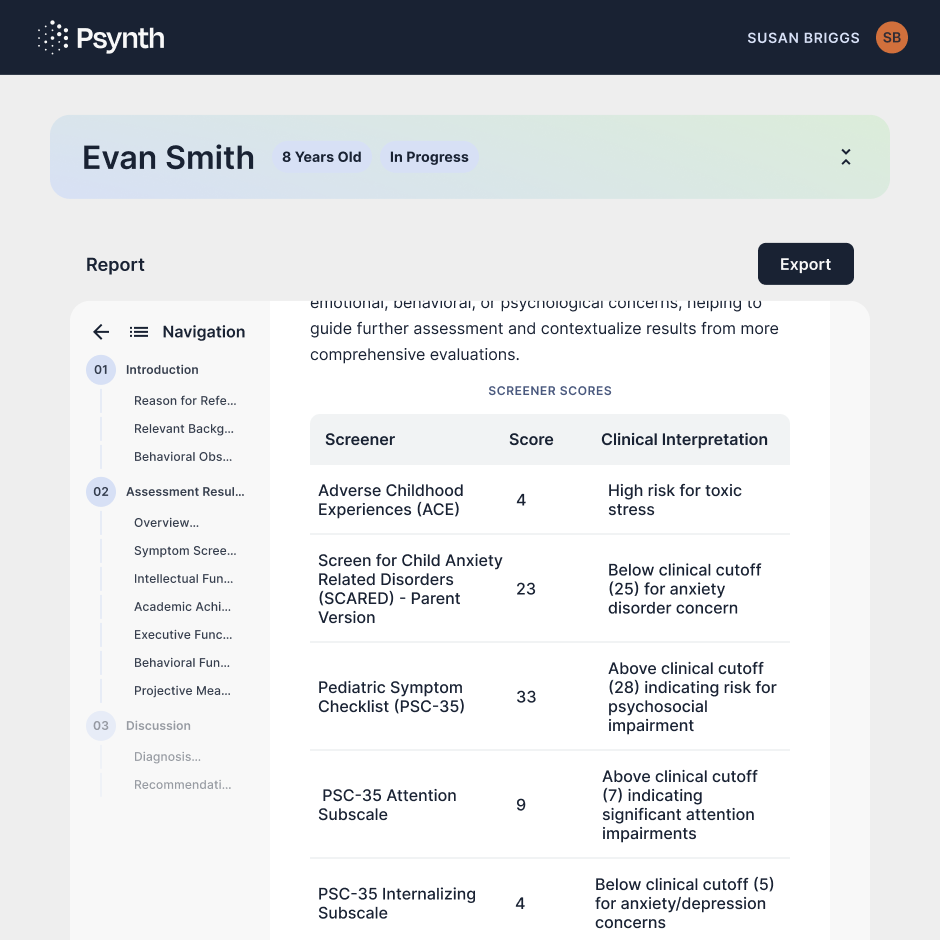
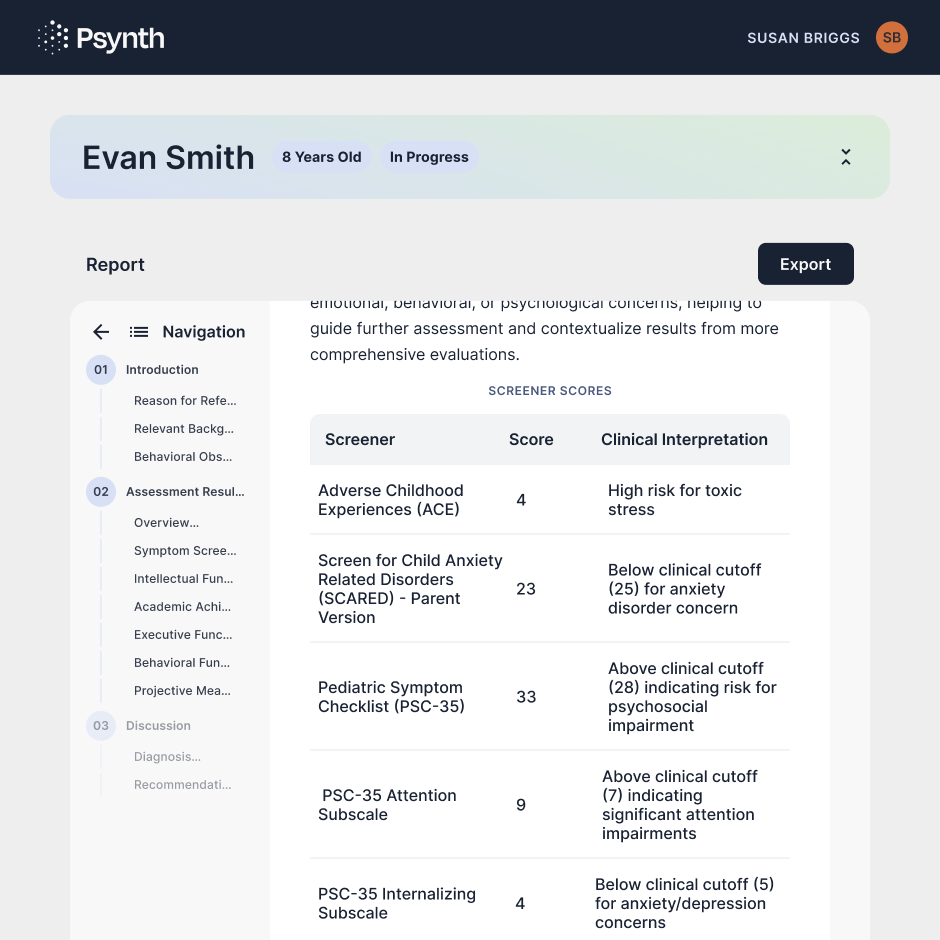
Psynth is built specifically for this workflow: it turns raw assessment data into a V1 Report draft that you then edit with your own clinical voice, and the school psychologists using it for psychoeducational evaluations are the ones who meet eligibility deadlines without staying up late every night.
The Weekend You Could Actually Have Back
Friday at 4 pm used to mean three more hours of report writing for many school psychs. It still does for too many. The psychology tools that are actually moving the needle aren't the ones promising to write reports for you; they're the ones that handle the synthesis grind well enough that your Friday at 4 pm is editing a solid first draft instead of staring at a blank template.
That's a meaningful difference. And it's worth finding out whether it works for your workflow before the next eligibility deadline hits.
If you want to see what that looks like in practice, Psynth's free trial is a low-friction way to try it on a real report and see how it handles your psychoeducational report sections so you can meet eligibility deadlines without working weekends.
Frequently Asked Questions
Can I regenerate only part of a report?
Yes. You can regenerate an individual section or select multiple sections when you want to apply the same instruction to them. Regenerated text remains draft material that requires psychologist review and editing.
Can AI replace a psychologist's clinical judgment?
No. AI can organize information, draft language, and surface patterns, but it cannot take responsibility for diagnosis, risk assessment, treatment decisions, or final report conclusions. The psychologist must review and verify the output and remains accountable for every clinical decision.
Is a BAA the same as HIPAA compliance?
No. A BAA is a contract stating a vendor agrees to comply with HIPAA. It does not verify that the vendor has implemented the required safeguards. Third-party verification through an accredited auditor confirms that actual controls are in place.
What is Psynth’s new Report Editor?
Psynth’s new Report Editor is a workspace for psychologists to review, edit, format, selectively regenerate, and export psychological reports. It gives clinicians more control after a draft is generated; it does not replace their judgment, approval, or sign-off.
What is the best AI psychology app?
There is no single “best” AI app for every psychologist. Your best option depends on your clinical goals and specific needs. Those who need help writing reports faster might want to consider Psynth's AI-enabled software. It helps you complete diagnostic reports in minutes, not hours.
See Psynth work in real time
We’ll demo an end-to-end report writing process and answer any questions along the way. (Yes, it’s so quick, we can get through it all during a single call.)