See All

Can You Record Assessment Sessions With AI? Consent, Minors and Forensic Limits
Yes, with informed consent and within limits. What the APA Ethics Code, state recording laws, test publishers, and forensic guidelines say about recording assessment sessions with AI.
Author

Reviewed By

Share This
Can You Record Assessment Sessions With AI? Consent, Minors and Forensic Limits
Yes, a psychologist can record an assessment session for AI documentation, provided everyone being recorded (or their legal representative) has given permission first and the recording stays within limits set by state law, test publishers, and the setting. The APA Ethics Code addresses this directly: under Standard 4.03, "Before recording the voices or images of individuals to whom they provide services, psychologists obtain permission from all such persons or their legal representatives."
The limits are where the real questions sit. Recording an intake interview differs from recording a test administration, and both differ from recording a forensic evaluation. Each is covered below with sources. This is general information, not legal advice, and rules differ by state and setting.

Informed consent comes first
Standard 4.03 requires permission before recording. Standard 3.10 on informed consent adds that psychologists should document consent. It says psychologists should "appropriately document written or oral consent, permission, and assent" (APA Ethics Code, 3.10(d)).
In practice, that means telling the client that the session will be recorded, what the recording is used for (in this case, drafting documentation), who can access it, how long it is kept, and that they can decline. Declining should not end the evaluation; fall back to manual notes.
HIPAA sits alongside this. Recordings and transcripts tied to an identifiable patient are generally treated as health information you must protect, and the Privacy Rule gives special handling to some mental health records. HHS explains how in its mental health FAQ. Whether a specific recording is part of the record is a question for counsel.
One-party vs. all-party consent states
Federal law sets a one-party baseline: you can record a conversation you are part of. Many states require everyone's consent. The Reporters Committee for Freedom of the Press, in its introduction to the Reporter's Recording Guide, lists about 11 all-party consent states: California, Delaware, Florida, Illinois, Maryland, Massachusetts, Michigan, Montana, New Hampshire, Pennsylvania, and Washington. It also notes that some other states require all-party consent for certain kinds of conversations, and that the guide "should not take the place of legal advice from a lawyer."
Two practical points follow. First, the Ethics Code already asks for permission from everyone, so a clinician who follows Standard 4.03 will generally meet even the strictest state rule. Second, telehealth can put the psychologist and client in different states. Which state's law applies is a legal question to settle with counsel before you record.
Minors: parent consent and child assent
For children, the Ethics Code sets a two-part approach. For persons who are legally incapable of giving informed consent, psychologists "(1) provide an appropriate explanation, (2) seek the individual's assent, (3) consider such persons' preferences and best interests, and (4) obtain appropriate permission from a legally authorized person" (APA Ethics Code, 3.10(b)).
For a recorded session with a minor, that usually means written permission from the parent or guardian, plus an age-appropriate explanation to the child and a real opportunity for them to say no. In custody or other contested matters, who is a "legally authorized person" can be in dispute, so check with counsel first.
Test security, copyright, and publisher rules
Recording test administration raises a separate issue. Pearson's legal policies state that "An audio or video recording of an administration where any test materials are recorded is a reproduction under federal copyright law," that doing so without written permission may infringe copyright, and that recording may invalidate the use of norm-referenced scores. Other publishers have their own terms, so check each instrument's license.
The APA Ethics Code frames the same concern in Standard 9.11: psychologists "make reasonable efforts to maintain the integrity and security of test materials... consistent with law and contractual obligations." The APA Committee on Psychological Tests and Assessment's Statement on Third Party Observers (2022), which it says is not official APA policy, discusses recording of evaluations and notes that an audio recording may be less intrusive than a video recording and that psychologists may want to limit who can access recordings.
A common approach is to use ambient capture for the interview, feedback, and history portions of an evaluation, and leave standardized test administration unrecorded unless the publisher's terms allow it. That is a workflow choice, not a rule, so confirm it against your own publishers' policies.
Forensic evaluations
Forensic work adds legal and adversarial considerations. The APA's Specialty Guidelines for Forensic Psychology (2013), in Guideline 10.06, say that when contemplating third-party observation or audio/video recording of examinations, forensic practitioners "strive to consider any law that may control such matters, the need for transparency and documentation, and the potential impact of observation or recording on the validity of the examination and test security."
Whether a recording is discoverable, whether an attorney or court must approve it, and how a retained expert should handle it depend on the jurisdiction and the engagement. Decide and document your approach in advance, and get the retaining attorney's position in writing. For more on forensic report structure, see our forensic psychological evaluation report checklist.
Telehealth and retention
Telehealth sessions add two questions: whose recording feature is running (yours, the platform's, or both) and where the file lives. Confirm where audio and transcripts are stored.
On retention, state licensing boards, payers, and your malpractice carrier may each set requirements, so check them before deciding how long to keep a recording or transcript.
How Psynth handles ambient listening
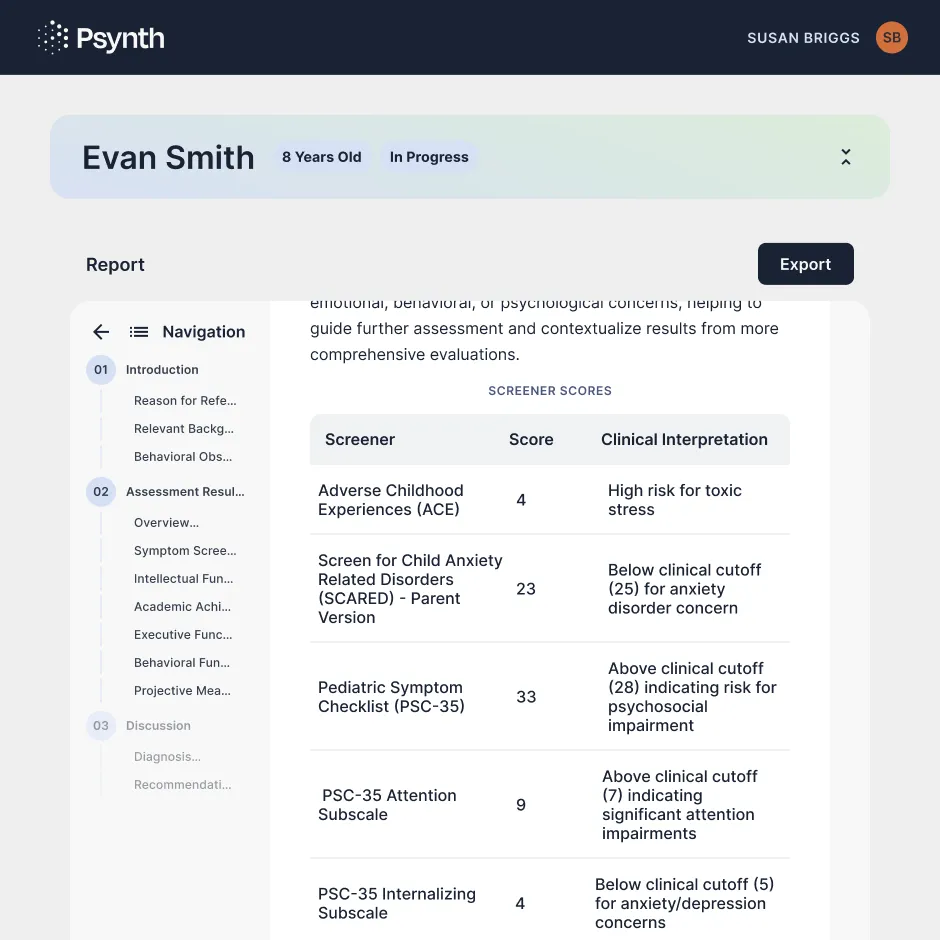
Ambient listening in Psynth is available as a paid add-on. It captures the session, shows live capture status, and alerts the clinician when it detects a problem such as a muted or disconnected microphone. It turns interviews and feedback sessions into editable drafts in the same workspace as the report.
The clinician stays responsible for obtaining consent and for reviewing every draft. Psynth does not make diagnostic decisions. Reports and uploads stay in your account until you delete them, or 90 days after you cancel. Psynth's AI vendors retain no data, and patient data is never used to train models. Psynth is HIPAA-, PIPEDA-, GDPR-, and SOC 2 Type 2-compliant. A business associate agreement is available on every plan. For how ambient scribes work across intake, testing, and feedback sessions, read Ambient AI Scribe for Psychologists. For how the capture itself should behave, see ambient listening for psychologists.
A short consent checklist
- Check your state's recording law, and the client's state if you practice by telehealth.
- Tell the client what you record, why, who has access, and how long you keep it.
- Get permission in writing (or documented oral permission) before recording starts.
- For minors, get parent or guardian permission and the child's assent.
- Offer a no-recording option that does not affect the evaluation.
- Do not record test administration unless the publisher's terms allow it.
- For forensic work, settle recording with the retaining attorney or court first.
- Review every AI-generated draft before it enters the record.
See how Psynth fits your workflow
Book a demo to see ambient listening and report drafting in one workspace.
Frequently Asked Questions
Is it legal to record a psychological assessment session?
Often yes, with consent. The APA Ethics Code requires permission from the people being recorded, and about 11 states require all-party consent for recording conversations. Laws vary, so confirm the rule for your state.
Do I need consent to use an AI scribe?
Yes, if the AI scribe records audio. Standard 4.03 requires permission before recording the voices or images of the people you serve, and you should document consent.
Can I record a minor's session?
With parent or guardian permission and the child's assent, where the child can give it. Standard 3.10(b) describes both steps.
Can I record test administration?
Check the publisher first. Pearson's policy says recording test materials is a reproduction under federal copyright law and may infringe copyright without written permission.
Can I use ambient AI in a forensic evaluation?
It depends on the jurisdiction and the engagement. The Specialty Guidelines for Forensic Psychology ask practitioners to consider controlling law, transparency and documentation, and effects on validity and test security.
Does Psynth include ambient listening?
Psynth offers ambient listening as a paid add-on. The clinician is responsible for consent and reviews every draft.
See Psynth work in real time
We’ll demo an end-to-end report writing process and answer any questions along the way. (Yes, it’s so quick, we can get through it all during a single call.)