
The Biopsychosocial Assessment Template We'd Actually Use (With a Filled-In Example)
A biopsychosocial assessment template psychologists can use today, with a filled-in example for a fictional client and a guide to each section.


A biopsychosocial assessment is a structured clinical evaluation that documents the biological, psychological, and social factors contributing to a client's presenting problem, then pulls them together into a formulation that guides diagnosis and treatment. The three domains are biological (health, medications, sleep, substance use, family medical history), psychological (symptoms, mental status, history, coping), and social (family, relationships, work or school, culture, finances, and safety).
The model comes from George Engel's 1977 paper in Science, "The Need for a New Medical Model: A Challenge for Biomedicine", which argued that a purely biomedical view leaves out the psychological and social dimensions of illness. Nearly fifty years later, the biopsychosocial assessment is still the backbone of most intake and evaluation workflows.
Below you'll find a template you can copy section by section, followed by a fully filled-in example for a fictional client.
What Is a Biopsychosocial Assessment Used For?
A biopsychosocial assessment gives the clinician a full picture of the person before setting a diagnosis or treatment plan. Clinicians usually complete it at intake, at the start of a psychological evaluation, or when a case becomes more complex than the referral question suggests.
In an assessment practice, it does three jobs:
- It frames the referral question. Knowing about a recent head injury, a medication change, or a family history of ADHD changes which measures you select.
- It supplies the history section of the report. Much of what you gather here becomes the background and history section of the final evaluation.
- It supports the formulation. Test scores tell you what. The biopsychosocial picture helps explain why.
If you already run a structured psychological intake, the biopsychosocial assessment is the organized, written version of what that intake uncovers.
Biopsychosocial vs. Psychosocial Assessment: What's the Difference?
A psychosocial assessment focuses on psychological and social functioning. A biopsychosocial assessment adds a structured biological domain: medical history, medications, sleep, neurological events, substance use, and family medical history.
For psychologists, that biological domain often matters most when the referral involves attention, memory, mood changes with a medical onset, or anything that could have a neurological or medication-related explanation. If you want the psychosocial version, our psychosocial assessment example walks through it in detail.
What Goes in a Biopsychosocial Assessment? (The Template)
Copy these sections into your intake form or report template. Each prompt is written so you can answer it in a sentence or two, then expand where the case needs it.
1. Identifying Information
- Name (or client ID), age, date of birth, pronouns
- Date(s) of assessment, assessing clinician, setting
- Referral source and reason for referral
- Sources of information (client interview, collateral interviews, records reviewed)
2. Presenting Problem
- The concern in the client's own words (a short quote works well)
- Onset, duration, frequency, and severity
- What prompted the referral now
- What the client hopes to get out of the assessment
3. Biological Domain
- Current and past medical conditions
- Current medications and supplements (name, dose, prescriber)
- Sleep, appetite, exercise, and energy
- Neurological history (head injury, seizures, loss of consciousness)
- Developmental history, if relevant (prenatal exposures, milestones)
- Substance use (alcohol, cannabis, nicotine, other substances, caffeine)
- Family medical and psychiatric history
4. Psychological Domain
- Current symptoms, organized by area (mood, anxiety, attention, thought, behavior)
- Past psychiatric history (diagnoses, hospitalizations, prior evaluations)
- Treatment history (therapy, medications, what helped and what didn't)
- Mental status observations (appearance, behavior, speech, mood and affect, thought process and content, cognition, insight and judgment)
- Coping strategies and personality factors
- Trauma history, at the level of detail appropriate to the setting
5. Social Domain
- Family of origin and current household
- Relationships and social support
- Education history and current school or work functioning
- Cultural, spiritual, and identity factors the client considers relevant
- Legal history
- Financial stressors, housing and access to care
6. Risk Assessment
- Suicidal ideation, intent, plan, and history of attempts
- Self-harm, harm to others, and access to means
- Protective factors
- Safety plan or actions taken, if any
7. Strengths and Resources
- Skills, interests, and past successes
- Supports the client can draw on during treatment
8. Formulation
Summarize how the three domains interact to produce the presenting problem. A common structure is the "4 Ps" grid, which crosses predisposing, precipitating, perpetuating, and protective factors with the biological, psychological, and social domains (PsychDB lays out the 3 x 4 version).
9. Diagnostic Impression
- Provisional or confirmed diagnoses with codes
- Rule-outs still open and what data would resolve them
10. Recommendations
- Further assessment (testing, medical workup, collateral records)
- Treatment recommendations and referrals
- Accommodations or follow-up plan
Biopsychosocial Assessment Example (Fictional Client)
Everything below is fictional. "Dana R." is not a real client, and the details were written to show how the template reads when filled in. Do not treat it as clinical guidance for any real case.
1. Identifying Information. Dana R., 34, she/her. Assessed over two sessions by a licensed psychologist in an outpatient practice. Self-referred at the suggestion of her primary care physician. Sources: client interview, a collateral phone interview with her spouse, and a PCP visit summary.
2. Presenting Problem. Dana reports, "I can't finish anything at work anymore, and I'm lying awake running through everything I forgot." Difficulty sustaining attention and increasing worry began about 18 months ago and worsened after a promotion six months ago. She asks whether she has ADHD, anxiety, or both.
3. Biological Domain. Hypothyroidism, diagnosed four years ago, managed with levothyroxine; last labs were over a year ago. No other medications. Sleep is five to six hours with trouble falling asleep. Reports four to five cups of coffee daily. Mild concussion from a bike fall at age 16, no loss of consciousness. Alcohol two to three drinks weekly; no other substances. Father treated for depression; brother diagnosed with ADHD in childhood.
4. Psychological Domain. Reports difficulty sustaining attention, misplacing items, and procrastinating, alongside daily worry, muscle tension, and irritability. Recalls being called "spacey" in elementary school but had no prior evaluation. Six months of therapy in college for anxiety, described as helpful. On mental status exam: casually dressed, cooperative, fidgeting throughout; speech normal in rate; mood "stressed," affect anxious and congruent; thought process linear; no perceptual disturbances; insight and judgment good.
5. Social Domain. Married, no children, lives with spouse, who describes her as "always forgetting things, but it's worse now." Bachelor's degree; now a project manager and recently promoted to lead a team of eight. Close with a sister. No legal history. Reports financial strain after a recent home purchase.
6. Risk Assessment. Denies current or past suicidal ideation, self-harm, or thoughts of harming others. No firearms in the home. Protective factors include a supportive marriage, work engagement, and prior positive therapy experience.
7. Strengths and Resources. Highly motivated, organized when interested in a task, strong verbal skills, runs twice a week, and has a supportive spouse and sister.
8. Formulation. Predisposing: family history of ADHD and depression; possible childhood attention difficulties. Precipitating: promotion with higher organizational demands; new financial stress. Perpetuating: short sleep, high caffeine intake, overdue thyroid labs, and worry about errors that further disrupt sleep and focus. Protective: insight, motivation, social support, exercise, and a good prior response to therapy. Attention difficulties may be long-standing and newly unmasked by higher demands, may be secondary to anxiety and poor sleep, or both. A thyroid contribution has not been ruled out.
9. Diagnostic Impression. Provisional: generalized anxiety disorder. Rule out: ADHD, predominantly inattentive presentation; attention symptoms secondary to thyroid function or insufficient sleep.
10. Recommendations. (1) Comprehensive psychological evaluation for attention and anxiety, including standardized rating scales from Dana and her spouse and a review of school records if available. (2) Coordinate with PCP to update thyroid labs before interpreting attention findings. (3) Sleep hygiene and caffeine reduction discussed; monitor over four weeks. (4) Follow-up feedback session after testing.
How Long Does a Biopsychosocial Assessment Take?
It depends on the setting, the case's complexity, and how many collateral sources you use. A straightforward outpatient case can be covered in a single intake session. Complex cases with multiple collateral interviews and records often take longer. Writing takes the most time, especially when notes, records, and collateral information arrive in different formats.
Who Completes a Biopsychosocial Assessment?
Psychologists, psychiatrists, licensed clinical social workers, licensed professional counselors, and other licensed mental health clinicians all complete them. Trainees and associate-level clinicians often complete them under supervision, with the supervisor co-signing. Who can complete and sign one depends on your state and setting, so check your licensing board's rules.
For a closer look at where this fits in the intake process, see what a mental health intake assessment covers.
Turning the Template Into a Report
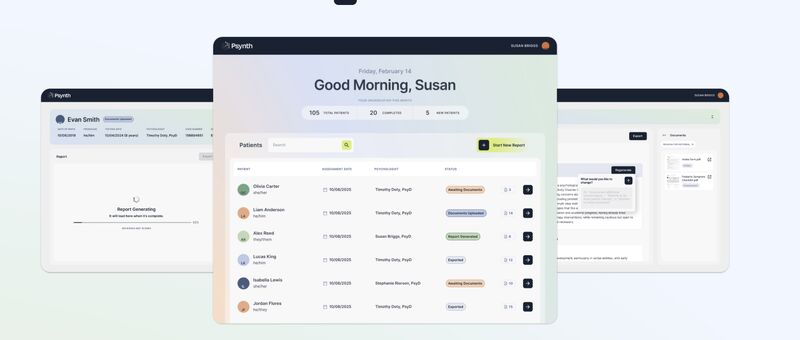
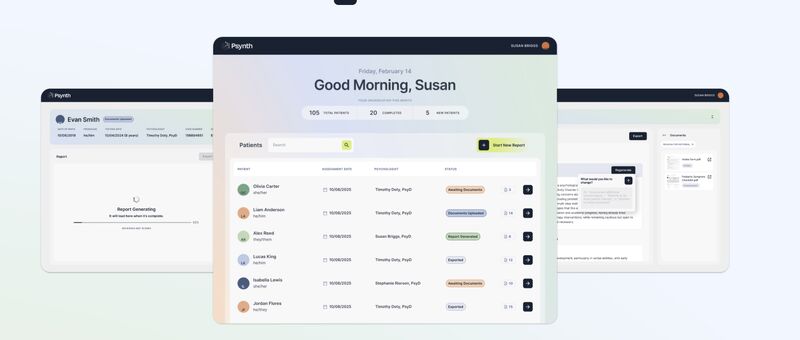
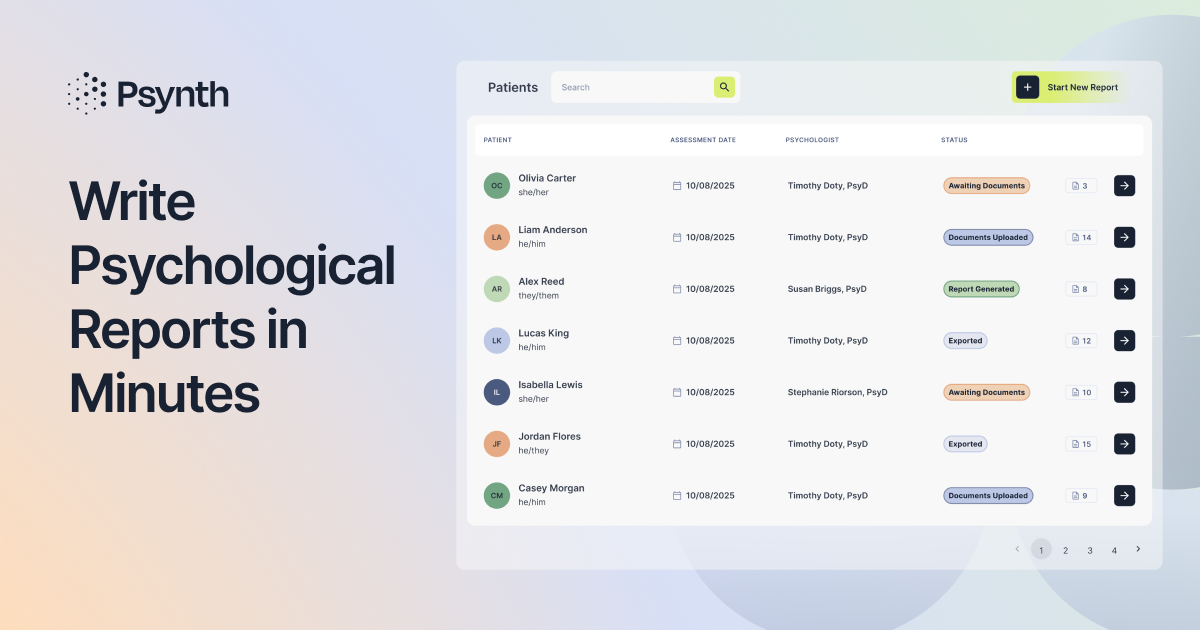
The biopsychosocial assessment usually feeds the history and background sections of a full evaluation report. Psynth is built for that step. It turns intake notes, PDFs, and test scores into a structured first draft of the report, and the psychologist reviews, edits, and signs it. With ambient listening, Psynth can also capture structured information from the intake interview as it happens, so you don't have to reconstruct the conversation from memory afterward. The clinician makes every diagnostic decision.
You can see how that works on the Psynth features page or on the Clinical page.
Try Psynth Free
Try Psynth For Free Spend your time on the formulation, not the formatting.
Frequently Asked Questions
What are the three domains of a biopsychosocial assessment?
Biological (medical history, medications, sleep, substance use, family medical history), psychological (symptoms, mental status, psychiatric and treatment history, coping), and social (family, relationships, school or work, culture, legal and financial factors).
Is a biopsychosocial assessment the same as a psychosocial assessment?
No. A psychosocial assessment covers psychological and social functioning. A biopsychosocial assessment adds a structured biological domain, which matters when medical, neurological, or medication factors could explain symptoms.
What goes in the formulation section?
A summary of how factors across the three domains combine to produce the presenting problem. Many clinicians use the 4 Ps (predisposing, precipitating, perpetuating, protective) crossed with the biological, psychological, and social domains.
Does a biopsychosocial assessment include a diagnosis?
It usually includes a diagnostic impression, which may be provisional. List rule-outs that need testing or medical input, along with the data that would resolve them.
Can I use AI to write a biopsychosocial assessment?
AI tools can draft the written assessment from your notes and records, but the clinician still reviews every section and makes every diagnostic decision. Before using any tool with client data, confirm it signs a business associate agreement and explains how it handles data. Psynth publishes its business associate agreement.
How often should a biopsychosocial assessment be updated?
Update it when something clinically significant changes, such as a new diagnosis, a medical event, a major life change, or a shift in risk. Your setting or payer may also set a review schedule.