
See All

Autism Evaluation Documentation That Holds Up
Struggling with autism evaluation documentation? Here's what actually goes into an ASD report that's defensible, clear, and doesn't eat your entire week.
Author

Reviewed By

Share This
Autism Evaluation Documentation That Holds Up
You finish the ADOS-2. You've got your algorithm scores, your observation notes, your parent interview from an hour and a half ago still open in three tabs. The kid was a lot. The family was a lot. And now you're staring at a blank report template at 6 pm thinking about how to turn all of that into something coherent, defensible, and actually useful to the people who are going to read it. That's the problem with autism evaluation documentation. It's not just paperwork. It's synthesis. And synthesis is exhausting when you've already been clinical all day.
What Makes ASD Documentation Different From Other Reports
The honest answer is: almost everything. With a lot of Psychological Testing and Assessment Reports That Work, you're integrating data from a few sources. ASD evaluations ask you to hold the ADOS-2 observation, the caregiver ADI-R or CARS-2 data, the developmental history, cognitive and language testing, school records, sometimes medical records, and your own clinical observations simultaneously, and then produce a narrative that explains how it all connects. Or doesn't connect. Because sometimes it doesn't.
The systematic review of clinical guidance documents for autism diagnostic assessment examined 11 professional and government guidance documents and found substantial variability in the recommendations across bodies. What holds across most of them is the expectation of multimodal assessment, integration of historical information with current observation, and a clear interpretive narrative that ties to diagnostic criteria. That's the floor. In practice, the ceiling is a lot higher.
What that means for your report is that every section is load-bearing. You can't write a thin developmental history and make up for it in the behavioral observations section. The CDC's guidance on autism diagnosis is explicit that DSM-5 criteria require evidence from multiple sources across multiple settings, and that pressure lands directly on documentation. If the data you collected doesn't make that case, you know it when you're writing. That's the uncomfortable part.

Why the Developmental History Section Carries More Weight Than People Give It
I'll admit I used to underwrite this section. Got better at the clinical interview over time, then summarized it in three paragraphs and moved on. That's a mistake.
The developmental history is doing real work. Regression, early language milestones, eye contact patterns in infancy, feeding and sensory sensitivities in toddlerhood- that's where you're building your case for onset before age 3 if you're documenting Criterion C under DSM-5. Without specificity there, your interpretive narrative is floating. The American Academy of Pediatrics' clinical guidance on identification, evaluation, and management of ASD emphasizes integrating historical information with objective observation, and in practice, that means the history must be detailed enough that someone reading the report without having met the family can reconstruct the developmental picture.
That's a lot of writing. It's also the section most vulnerable to Informant Discrepancy Interpretation Guide for BASC-3 problems, because parents sometimes contradict each other, what they report in the intake doesn't match what teachers describe, or there's a custody dispute quietly running underneath the whole evaluation. Document the discrepancies. Explain your reasoning for how you weighted them. Don't pretend the inconsistencies didn't happen.
[KEY TAKEAWAY: Developmental history isn't background filler — it's diagnostic evidence. Write it like you'll have to defend it.]
How Do You Document ADOS-2 Findings Without Just Repeating the Scores
This is the question I get most from early-career clinicians, and honestly, it's the right question.
The algorithm score matters. Document it. But the ADOS-2 score is not a diagnosis, and your report shouldn't read as if it were. What readers need, whether that's a school psychologist, a pediatrician, or an educational advocate, is a description of what you actually observed. The quality of social reciprocity during the task. Whether initiation was present but atypical. What the restricted and repetitive behavior items looked like in the room. That observational narrative is what makes an ASD report legible and defensible.
▶ What should my autism assessment feedback and report cover?
The ETS policy on autism documentation requirements for accommodation purposes (useful even when you're not writing for that context) is explicit about needing a description of current functional impact alongside scores. That framing is helpful. Score, observation, functional implication. For each relevant domain. You're not just summarizing the ADOS-2 module; you're explaining what the examiner saw and what it means for how this person moves through the world.
The CARS-2 data, if you're using it, needs the same treatment. Raw score plus subscale interpretation plus a sentence or two on what caregivers' ratings reflect about home and community functioning. How Cognitive Load Destroys Assessment Scoring Accuracy matters here too, especially when you're integrating caregiver-report instruments with direct observation data that doesn't fully align.
Documenting DSM-5 Criteria Without Making the Report Sound Like a Checklist
This is harder than it sounds. The DSM-5 gives you two criteria, A and B: social communication and interaction, and restricted and repetitive behaviors. You need to address both. You need to document the specifiers. Severity level. Presence or absence of intellectual impairment, language impairment, and associated conditions.
But if your report literally walks through Criterion A1, Criterion A2, Criterion A3, it reads like a checkbox exercise and loses the clinical thread. The research on evidence-based assessment of autism in children and adolescents has long pointed in this direction: select instruments with adequate psychometric properties and interpret them within the full clinical context. The documentation should reflect that integration, not just reflect the instrument structure back at the reader.
What works better is a narrative that addresses the criteria through the clinical picture. "Across direct observation, caregiver report, and review of school records, this evaluator observed persistent deficits in social-emotional reciprocity characterized by..." That framing does the DSM-5 work without making the report feel like a form someone filled out.
The functional limitations section is where many reports drop the ball, too. Documenting that someone has ASD isn't the same as documenting how ASD affects their daily functioning, their learning, their relationships, their ability to manage transitions or sensory demands. That section is what families actually use to advocate, and it's what school teams use to write IEPs. Write it with that reader in mind.
[KEY TAKEAWAY: DSM-5 criteria documentation should read like clinical reasoning, not like a completed checklist.]
What Goes Wrong When Documentation Gets Rushed
Honestly, most of it. Thin behavioral observation sections. Developmental histories that are two paragraphs long. ADOS-2 findings that just restate the algorithm total without any interpretive narrative. Functional impact sections that are copy-pasted from a template and don't reflect the specific kid sitting across from you.
And look, I get it. If you're running a solo practice doing a high volume of psychoeducational and ASD evaluations, the cognitive load by the time you sit down to write is significant. Decision fatigue is real. Working memory has limits, and after a full day of testing, it's not at its best. That's not a personal failure; it's a documented phenomenon. The Job Demands-Resources model would predict exactly this: high-demand work without sufficient recovery resources depletes the clinician and the product suffers.
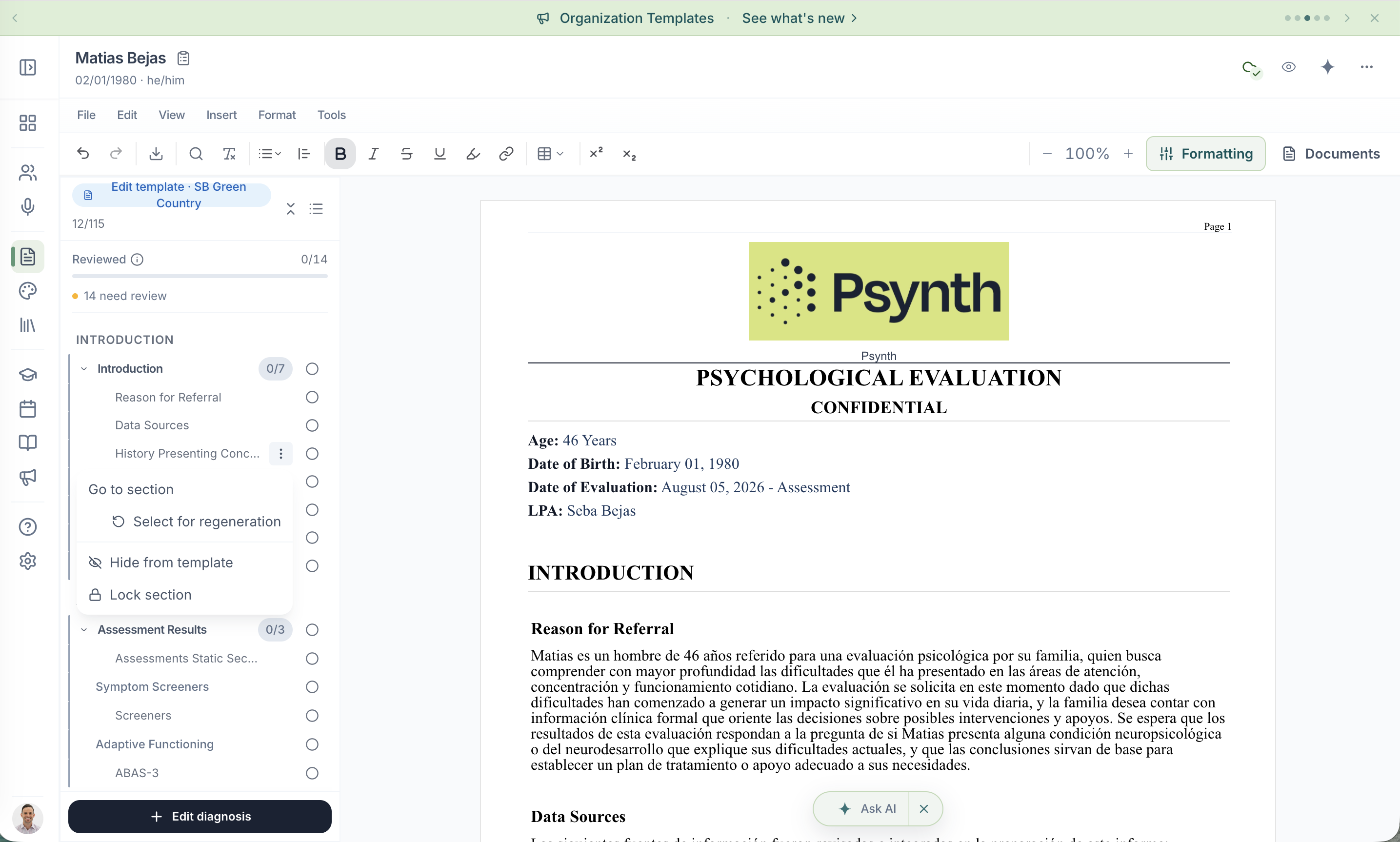
This is partly why some colleagues I know have started using Psynth; it turns the raw ADOS-2 and CARS-2 data into a structured first draft so the interpretive narrative has something to push against rather than starting from a blank page. Dr. Lexie Molina went from 3-4 hours per report to about 15 minutes for a V1 Report. That's not magic; that's having somewhere to start.
The What Tools Do Psychologists Use? (Types and Examples) question is genuinely evolving, and ASD documentation is one of the areas where the demands of synthesis are high enough that having a purpose-built drafting layer actually changes what's possible in a day.
Getting Autism Evaluation Documentation Right Isn't About Templates
It's about having a clear model of what the document needs to do and enough cognitive bandwidth left at the end of the day to execute it. The sections aren't arbitrary. The developmental history, behavioral observations, ADOS-2 findings, DSM-5 interpretation, and functional impact- they're all doing clinical work. When any one of them is thin, the whole report is weaker.
ASD evaluation documentation, when done well, is one of the most demanding report types in the field. That's just true. If you're feeling the weight of it week to week, that's not a sign you're doing it wrong; it's a sign the task is actually hard.
If you want to see what a structured first draft looks like before you start editing, Psynth's free trial lets you run a real report and see where it saves you time. Psynth drafts ASD evaluation sections from your ADOS-2 and CARS-2 data; try it on your next report.
Frequently Asked Questions
Can a psychosocial assessment be used in schools or workplaces?
Yes. In schools, psychosocial information often feeds into broader evaluations — for example, a functional behavioral assessment used to understand a student's disruptive behavior may draw on similar psychosocial domains (family, environment, functioning). In workplaces, psychosocial assessments can inform accommodations, employee assistance programs, or fitness-for-duty evaluations. The scope and formality typically differ from a clinical/treatment-planning assessment, and confidentiality and consent requirements vary by setting.
Can I create different styles for different report types?
Yes. Under Report Look in Formatting, Style Panes let you create multiple report styles for different report types, contracts, or presentation needs. Review the final presentation for the specific report and audience before delivery.
Can I see my psychologist's notes?
Clients can usually access their official records, such as progress notes, but not private process notes. Psychologists may withhold notes that could cause harm or violate mandatory reporting laws. Access depends on clinic policy, documentation type, and legal requirements within your state or country.
Is Psynth compliant with PIPEDA?
An independent audit body has attested Psynth's compliance with PIPEDA, Canada's federal privacy law.
How do I start using Psynth?
Start a free trial directly in the Psynth app, then email support@psynth.ai to redeem the AU and NZ pricing offer.
See Psynth work in real time
We’ll demo an end-to-end report writing process and answer any questions along the way. (Yes, it’s so quick, we can get through it all during a single call.)