

Psynth for Canadian Psychologists: Faster Assessment Reports, With Patient Data That Stays in Canada


Psynth for Canadian Psychologists: Faster Assessment Reports, With Patient Data That Stays in Canada
Key takeaways
- Canadians routinely wait 6 to 18 months, sometimes longer, for a psychological assessment in the public system, and the shortage of psychologists is structural, not temporary.
- Private assessments often run $2,000 to $4,500 because a single report can take 15 to 18 hours of a psychologist's time.
- Psynth turns that 15-hour report into a reviewable first draft in minutes, so clinicians can see more families without working more nights.
- Canadian patient data is stored and encrypted in Canada. Psynth is independently audited for PIPEDA compliance and provisionally compliant with provincial health-privacy law.
A family in Ontario can wait more than a year for a publicly funded psychoeducational assessment. The psychologist who could answer their questions is usually booked months out, spending fifteen hours on one report while the next child waits. The bottleneck is rarely clinical skill. It is the hours that vanish into scoring, integrating, and writing.
Psynth has been supporting psychologists across Canada for a while now, and we built the Canadian side of our platform around one rule we refused to bend: patient data stays in Canada. This post lays out the problem Canadian clinicians are up against, what it costs families, and how Psynth fits, including exactly where your data lives.
Why do Canadians wait so long for a psychological assessment?
Canada has roughly 19,500 psychologists, according to Statistics Canada, and ranks near the bottom of comparable universal-access countries for psychologists per capita. The public system cannot keep pace. Western University's Dr. David Dozois has described a serious shortage in the public hospital system, with patients in the public stream often waiting six months to a year or more, while those who can pay privately are seen far sooner.
The pipeline is the root cause. The doctoral route into the profession averages about seven and a half years, graduate numbers have stayed flat, and the country loses psychologists faster than it replaces them. The effect shows up in the national data: a 2024 study published in PLOS Mental Health found that half of Canadians who sought mental health care ran into significant barriers, and a third struggled to find help for conditions like PTSD and depression.
Assessments are where the backlog bites hardest. In New Brunswick's anglophone school system, only six of forty-five psychologist positions are filled, and roughly two-thirds of the province's psychologists work in private practice rather than the public system. Families who cannot wait pay out of pocket.
What does a private assessment cost in Canada, and why?
A private psychoeducational assessment in Ontario commonly runs $2,000 to $4,500, with most clinics charging between $2,500 and $3,500. Comprehensive, multi-domain evaluations reach roughly $4,850, and autism assessments often land between $4,500 and $5,000. In British Columbia, a full psychoeducational assessment by a registered psychologist typically runs $1,500 to $3,500.
The price reflects time, not markup. A comprehensive psychoeducational assessment takes roughly 15 to 18 clinical hours: intake and history, administering and scoring measures like the WISC-V and BASC-3, integrating collateral input, writing the report, and delivering feedback. For many families the report is not optional. A psychoeducational report from a registered psychologist is typically required to support a Disability Tax Credit claim worth $1,500 to $2,500 a year, and to secure school accommodations.
So the math is hard on both sides. Families face a year-long public wait or a four-figure private bill. Psychologists face a ceiling on how many children they can help, set by how many reports they can physically write.
How Psynth helps Canadian psychologists see more families
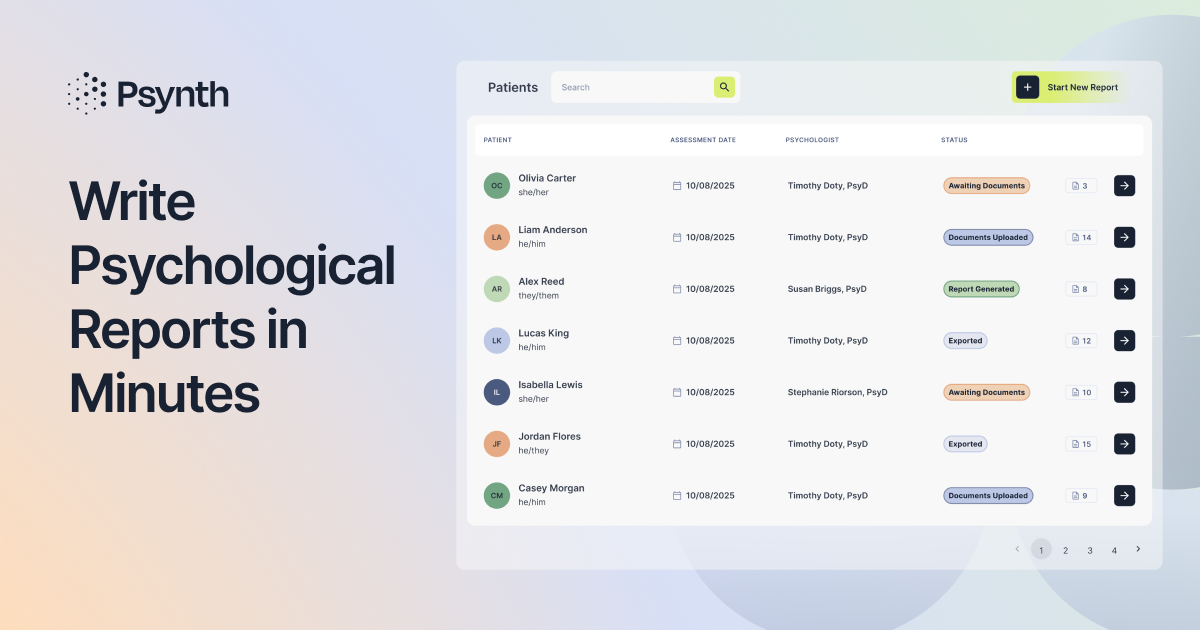
Psynth is purpose-built to automate the report, not the clinician. You bring the raw material: handwritten notes, score reports, PDFs, qualitative observations. Psynth turns it into a PhD-smart first draft in minutes, organized test by test, across more than 370 supported assessments. You review, refine, and decide. The diagnosis is always yours.
What that does to a practice:
- Dr. Lexie Molina, a solo practitioner, went from three to four hours per report to a first draft in about fifteen minutes. She has not worked a weekend since.
- Dr. Taylor Fladhammer's high-volume practice saw report speed improve roughly fourfold and assessment capacity grow two to three times, without adding staff.
For a Canadian psychologist staring at a waitlist, that capacity is the whole point. Every hour returned to clinical work is an hour against the queue, and a family that gets answers this month instead of next year.

Where does Canadian patient data live? (PIPEDA, PHIPA, and provincial privacy law)
This is the question Canadian psychologists ask first, and rightly. Here is the straight answer.
Canadian patient data is stored and encrypted at rest in Canada. When Psynth drafts a report, the relevant data is sent to AI servers in the United States for the drafting step only. It is never stored there, and it is deleted immediately after the draft is generated. That is what we mean by zero-retention: nothing about your patient lingers on a processing server once the work is done. Every action is captured in complete audit logs.
We are transparent about that brief cross-border step on purpose, because Canadian privacy law expects it. Neither PIPEDA nor provincial health-privacy law forces data to be processed entirely inside Canada, but both expect you to know where it goes and to keep control of it. Under laws like Ontario's PHIPA, the psychologist remains the health information custodian. Psynth is the service provider that holds the data to your standard, so your obligations stay met.
On formal standing:
- PIPEDA: An independent audit body has attested Psynth's compliance with PIPEDA, Canada's federal private-sector privacy law.
- Provincial health-privacy law: Psynth is provisionally compliant with the provincial regimes that govern Canadian practices, including Alberta's HIA, Ontario's PHIPA, British Columbia's PIPA, and the Personal Health Information Acts (PHIA) of Nova Scotia, Manitoba, and Newfoundland and Labrador, on the strength of Canadian data residency and full audit logging.
- SOC 2 Type 1: Psynth's security controls are independently examined under SOC 2 Type 1.
You can review our current security and privacy posture at trust.psynth.ai.

Canadian launch pricing
For a limited time, Canadian psychologists can use Psynth at launch pricing: $99 USD per month and $25 USD per report. A single private assessment in Canada bills in the thousands, so one report covers a full month of Psynth many times over, and you keep the hours you used to lose to writing. To claim the launch rate, email support@psynth.ai and let us know you are a Canadian practice.
See it on one of your own assessments
If you are a Canadian psychologist spending nights and weekends on reports, Psynth can give those hours back. Book a demo and we will build a first draft from one of your own assessments, so you can judge the quality before you decide anything.
Frequently Asked Questions
Does Psynth store Canadian patient data in Canada?
Yes. Canadian patient data is stored and encrypted at rest in Canada.
Is patient data ever sent to the United States?
Only for the drafting step. Data is sent to US-based AI servers momentarily while the report is generated, is never stored there, and is deleted immediately afterward.
Is Psynth compliant with PIPEDA?
An independent audit body has attested Psynth's compliance with PIPEDA, Canada's federal privacy law.
What about PHIPA, HIA, and other provincial health-privacy laws?
Psynth is provisionally compliant with provincial health-privacy regimes including Alberta's HIA, Ontario's PHIPA, British Columbia's PIPA, and the Personal Health Information Acts (PHIA) of Nova Scotia, Manitoba, and Newfoundland and Labrador, supported by Canadian data residency and audit logging.
How much does Psynth cost for Canadian psychologists?
For a limited time, Canadian psychologists can use Psynth at launch pricing of $99 USD per month and $25 USD per report. To claim the launch rate, email support@psynth.ai and let us know you are a Canadian practice.
Does Psynth diagnose patients or replace the psychologist?
No. Psynth drafts and organizes the report. The psychologist reviews it, makes the diagnosis, and signs off. The clinician is always in the loop.