
Competency to Stand Trial Evaluations: What the Report Has to Cover
What a competency evaluation report must cover: the Dusky standard, core report sections, malingering, and the common reasons CST reports get challenged.


A competency evaluation is a forensic assessment of whether a criminal defendant can presently understand the proceedings against them and work with their attorney. The report must answer that question under the Dusky standard, link any mental condition to specific trial-related abilities, address response style, and give the court an opinion on restorability if the defendant appears incompetent.
October is a fitting month to talk about things that come back to haunt you, and in forensic practice that is usually a thin report. Competency reports are often the only product of the evaluation. The AAPL Practice Guideline for the Forensic Psychiatric Evaluation of Competence to Stand Trial notes that because these evaluations "often do not result in courtroom testimony, a written report usually is the chief product." What follows is what that report needs to include, and where it tends to break down.
This post is general education for psychologists. It is not legal advice. Competency statutes, report requirements, and ultimate-issue rules vary by state, so check your jurisdiction's law and your court's order.
For the general structure every forensic report shares (notification of purpose, sources, separating observations from inferences), see our section-by-section forensic psychological evaluation report checklist. This post covers what's specific to competency to stand trial (CST).
What is competency to stand trial? The Dusky standard
Competency to stand trial is a defendant's present capacity to participate in their own criminal case. The constitutional floor comes from Dusky v. United States (1960), and most state statutes build on its language.
In Dusky, the Supreme Court held that the test is whether the defendant has "sufficient present ability to consult with his lawyer with a reasonable degree of rational understanding" and whether he has "a rational as well as factual understanding of the proceedings against him."
That gives the report three prongs to address:
1. Factual understanding of the proceedings (charges, roles of courtroom participants, possible outcomes)
2. Rational understanding of the proceedings as they apply to this defendant
3. Ability to consult with counsel with a reasonable degree of rational understanding
Later cases shaped how evaluators apply it:
- Drope v. Missouri (1975) added that a defendant must be able "to assist in preparing his defense" and that courts must stay alert to changes in competence during trial.
- Godinez v. Moran (1993) held that competence to plead guilty or waive counsel is measured by the same Dusky standard, and noted that defendants must make important decisions during a case.
- Indiana v. Edwards (2008) allowed states to require counsel for defendants who are competent to stand trial but, because of severe mental illness, not competent to represent themselves.
- Cooper v. Oklahoma (1996) struck down a law requiring defendants to prove incompetence by clear and convincing evidence.
Federal cases follow 18 U.S.C. § 4241, which asks whether a defendant is "presently suffering from a mental disease or defect" that renders them unable "to understand the nature and consequences of the proceedings against him or to assist properly in his defense."
Present ability is the key phrase. A CST report is not about mental state at the time of the offense. Mixing the two is one of the fastest ways to get a report challenged.
What questions does a psychologist ask to assess competency to stand trial?
A psychologist asks about the charges, possible penalties, the roles of the judge, prosecutor, defense attorney, and jury, plea options, and how the defendant would work with their lawyer. They also ask the defendant to describe events around the arrest and assess how symptoms affect reasoning and communication.
The AAPL guideline recommends asking evaluees "to describe their versions of events before, during, and after the alleged offense." The point is not to establish guilt. It is to see whether the defendant can give counsel a coherent, consistent account.
Structured instruments can organize this part of the interview. The AAPL guideline discusses the MacArthur Competence Assessment Tool-Criminal Adjudication (MacCAT-CA) and the Evaluation of Competency to Stand Trial-Revised (ECST-R), which was built around the three Dusky elements and includes scales for atypical symptom presentation. The guideline is clear that these tools are "one source of information" and should not be used as stand-alone tests of competence.

What the competency evaluation report has to cover
There is no single required format. The AAPL guideline says "there is no single correct style or format," and many state systems publish their own templates. Federal reports under 18 U.S.C. § 4247(c) must include the person's history and present symptoms, the tests used and their results, the examiner's findings, and opinions on diagnosis, prognosis, and the competency question.
Drawing on the AAPL guideline's report section, here's what a competency-to-stand-trial evaluation report should include.
Introduction and legal standard
- Court, case number, charges, referring party, date of the order
- The jurisdiction's competency standard, cited
- Date, location, and length of each interview
- How the defendant was notified of the purpose and lack of confidentiality, and how well they understood it
- Every data source, including records requested but not received
Background, limited to what bears on competency
The AAPL guideline says CST background sections "need not be as detailed or extensive" as criminal responsibility reports. Include psychiatric history, treatment response, cognitive history, and legal history that bear on present capacity or restoration.
Leave out incriminating details from the defendant's account of the offense. The AAPL guideline warns that prosecutors often receive the report and that statements may later be used if the defendant testifies inconsistently. Describe the quality of the account (coherent, consistent, detailed) instead of its content.
Mental status and clinical findings
Report findings relevant to competency, including contradictions. The guideline notes that a mental status exam "does not by itself provide a description of those functional abilities" the law cares about. It also notes that a defendant who is psychotic or has amnesia "is not necessarily incompetent to stand trial."
Functional abilities: the heart of the report
This is where the report earns its keep. The AAPL guideline calls the description of "abilities and deficits concerning the tasks that the defendant must perform during a criminal defense" the heart of a competence report.
Organize it by Dusky prong. For each one, give the defendant's actual responses, the structured instrument results if used, and how the symptoms you documented do or don't impair that ability.

Diagnosis
The AAPL guideline supports including a diagnosis, in part because many statutes, including the federal one, require the examiner to address "mental disease or defect." Explain it in plain language and tie it to the functional findings. A full diagnostic workup is rarely needed; include what is "necessary and relevant to the legal question."
Opinion and restorability
- The opinion on each prong, and on the ultimate question only if your jurisdiction allows or requires it
- The reasoning linking clinical findings to each element of the standard
- If the defendant appears incompetent: an opinion on restorability, the likely time frame, and the appropriate setting
Restoration matters because Jackson v. Indiana (1972) held that a defendant cannot be committed indefinitely solely because of incompetence to stand trial. Federal law limits hospitalization to determine restorability to "a reasonable period of time, not to exceed four months" under § 4241(d). State timelines differ.
The AAPL guideline also says reports "should be free of gratuitous comments" about dangerousness or lack of remorse unless the jurisdiction requires them.
Malingering considerations in CST evaluations
Response style gets its own section because courts raise it often. The AAPL guideline cites two 1990s reports suggesting "at least ten percent of defendants referred for competence evaluations attempt to feign" impairment.
A few practices keep this section defensible:
- Use more than one method. Feigning assessment in forensic settings relies on converging evidence, not a single score (Walczyk et al., Frontiers in Psychiatry, 2018). Commonly used measures include the SIRS-2, M-FAST, and TOMM, alongside validity scales on broadband instruments and the ECST-R atypical presentation scales.
- Match the measure to the claim. Feigned psychosis, feigned cognitive impairment, and feigned legal ignorance call for different tools.
- Separate feigning from competence. A defendant can exaggerate symptoms and still have a genuine impairment. Report both findings and explain how each bears on each Dusky prong.
- Consider repeat evaluations carefully. CST defendants are often seen more than once. Rogers, Vitacco, and Kurus (JAAPL, 2010) studied SIRS stability across repeat administrations in genuine forensic inpatients; their abstract notes questions remain for other feigning measures.
Common reasons competency reports get challenged
When CST reports are challenged, it is usually for one of these reasons:
1. Wrong time frame. The report discusses mental state at the time of the offense instead of present ability.
2. Diagnosis without function. The report lists symptoms and a diagnosis but never links them to a Dusky prong.
3. Instrument as verdict. A MacCAT-CA or ECST-R score is presented as the answer rather than one source.
4. Unsupported malingering conclusions. Feigning is asserted from one measure, or treated as automatic proof of incompetence.
5. Incriminating content. The defendant's account of the offense appears in detail.
6. Missing restorability opinion for a defendant found incompetent.
7. Stale findings. Drope reminds courts that competence can change. A report more than a few weeks old may need an update before a hearing.
8. Ultimate-issue mismatch. The report gives or omits the ultimate opinion contrary to local practice.
Most of these come back to the same habits covered in what makes psychological reports defensible: show the reasoning, not only the conclusion.
Where Psynth fits
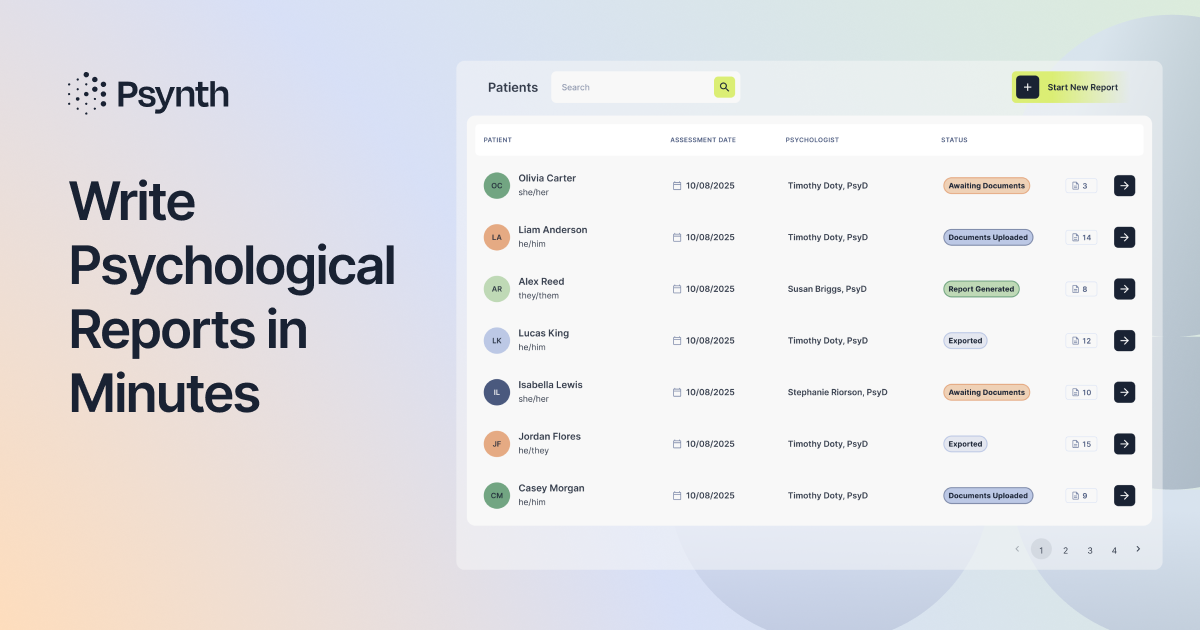
CST evaluations carry heavy record loads and tight court timelines. Psynth drafts psychological reports test by test from the data you upload, and the psychologist reviews, edits, and signs the final report. Its no-retention AI vendors and SOC 2 Type 2 compliance are documented on the Psynth security page.
Frequently Asked Questions
How long does a competency evaluation take?
It depends on the case and setting. Outpatient evaluations may involve one or more interviews plus record review. In federal cases, 18 U.S.C. § 4247(b) allows commitment for examination "not to exceed thirty days," with a possible extension of up to 15 days.
What happens if a defendant is found incompetent to stand trial?
Proceedings are usually paused while the defendant receives treatment to restore competence. Under Jackson v. Indiana, confinement cannot be indefinite solely because of incompetence. If restoration is unlikely, states typically turn to civil commitment or dismissal, depending on the law.
Is competency to stand trial the same as an insanity defense?
No. Competency concerns the defendant's present ability to understand the proceedings and work with counsel. Insanity (criminal responsibility) concerns mental state at the time of the offense. They are different legal questions, and the AAPL guideline recommends a separate report when a court asks for both.
Can a defendant with a psychotic disorder be competent?
Yes. A diagnosis does not decide competency. The question is whether symptoms impair the specific abilities in the Dusky standard. The AAPL guideline notes that psychosis or amnesia does not by itself make a defendant incompetent.