

Psynth UK: Report-Writing Software for Psychologists


Psynth is now available in the UK
Report-writing software built for psychologists is now live for practices across the United Kingdom. Here is why we came, who it is for, and how your clients’ data is protected under UK law.
If you are a psychologist in the UK, you are not short on referrals. You are short on hours.
Demand for assessment has climbed to levels the system was never built to hold, and the bottleneck is rarely the clinical decision. It is the report. The hours after the session spent turning scores, observations, and developmental history into something a family or a school can actually use.
Psynth has been live with UK practices for the past two months. Today we are making it official. Psynth is open to psychologists across the United Kingdom.
The UK is facing an assessment backlog without modern precedent
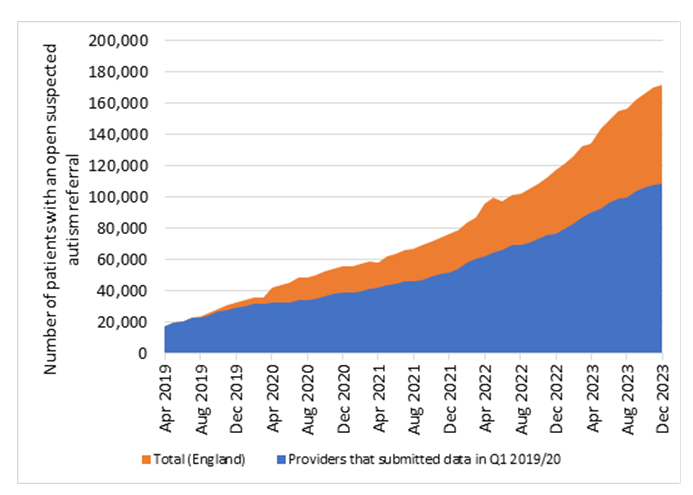
The numbers are stark. Government figures show 13 times more people were waiting for an autism assessment in September 2025 than in April 2019. As of March 2025, NHS England data placed 137,977 children on the waiting list for an autism assessment, with around nine in ten waiting at least 13 weeks, and estimated that up to 316,000 children were waiting for an ADHD assessment. A 2024 review found more than 549,000 people in England waiting for an ADHD assessment, with roughly 144,000 already past the two-year mark. In some regions the wait now runs to several years, and in the worst cases approaches a decade.
This is not a blip. The share of working-age adults with a common mental health condition rose from 15.5 percent in 1993 to 22.6 percent in 2023 to 2024. More people are seeking assessment, and more of them are turning to private and independent practitioners to get it.
There are not enough psychologists to clear it
Capacity has not kept pace. The British Psychological Society’s workforce census recorded a 16 percent vacancy rate across practitioner psychologists, and psychologists now sit on the Migration Advisory Committee’s shortage occupation list. Around one in seven NHS posts go unfilled.
Educational psychology is under even more strain. Research commissioned by the BPS estimates England needs roughly 40 percent more educational psychologists, with provision ranging from one EP for every 480 pupils in better-served areas to one for every 9,400 in the worst. Close to nine in ten local authorities report difficulty recruiting, while only just over 200 funded training places were available in 2025 to 2026 against a profession that loses people every year.
You cannot hire your way out of a shortage this size at the speed families need. The capacity has to come from somewhere else.
The hidden tax is the report, not the assessment
Here is the part that rarely makes the headlines. For most psychologists, the assessment is not what eats the week. The write-up is. A thorough psychoeducational, neurodevelopmental, or neuropsychological report can take three to four hours, and it often lands on a Sunday. Every one of those hours is an hour not spent with the next person on your list.
That is the constraint Psynth was built to remove.
What Psynth does
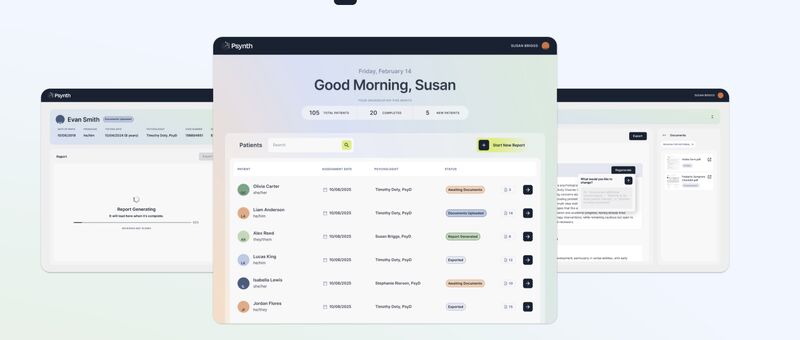
Psynth is purpose-built to take the raw material of an assessment, your handwritten notes, PDFs, score reports, and qualitative observations, and produce a PhD-smart first draft in minutes rather than hours.
It does not diagnose, and it does not replace you. The clinician is always the human in the loop. Psynth surfaces the patterns and drafts the language. You interpret the data, you make the call, and you sign your name. The platform supports more than 370 assessments, including the instruments you already use, such as the WISC-V, BASC-3, ADOS-2, Vineland and DIVA-5, and it works test by test, so there is no mixing of client data across reports.
Dr. Fladhammer, who runs a high-volume practice, reports two to three times the assessment capacity and four times faster reports after switching to Psynth. Dr. Molina went from three to four hours per report to a first draft in about 15 minutes, and has not written a report on a weekend since.
Built for UK data protection
Psychological assessment data is some of the most sensitive information there is. Under UK GDPR and the Data Protection Act 2018, it is special category data, which carries a higher bar: an Article 9 condition, the associated Schedule 1 conditions, and documented safeguards. Psynth is built to meet that bar.
- Your role and ours. You remain the data controller. Psynth acts as your data processor under a UK GDPR Article 28 data processing agreement.
- A UK representative. Psynth has appointed a UK representative under UK GDPR Article 27.
- Where your data lives. All UK client data is stored at rest in Ireland. The UK recognises the European Economic Area, including Ireland, as providing an adequate level of protection, so storing your data there requires no additional transfer safeguards.
- Zero retention. Report drafting runs on a zero-retention basis. Once your draft is generated, the processing layer keeps nothing, and international transfers are governed by UK GDPR with appropriate safeguards.
- Independently verified. Psynth is verified to SOC 2 Type 2 and ISO 27001 by Assured Information Solutions, an independent third party, and operates to GDPR and UK GDPR standards. You can review the detail at trust.psynth.ai.
- A UK cluster is coming. Ireland is the home for UK data today. A dedicated UK cluster is on our roadmap.
Who Psynth is for in the UK
If you write assessment reports, Psynth is built for you. In the UK that includes:
- Private practitioners running ADHD and autism assessments, where private turnaround now averages a matter of weeks against NHS waits of years.
- Educational Psychologists producing independent and EHCP-related reports, where an independent EP assessment carries real weight in an EHCP application.
- Neuropsychologists working through complex, multi-measure batteries.
- Forensic psychologists preparing detailed, defensible reports.
- Practice owners who need more capacity per clinician without hiring into a national shortage.
The economics are simple
In private practice, the report is the product. A private ADHD assessment averages around 1,200 pounds, autism assessments commonly run from 1,400 to 4,200 pounds, and an independent Educational Psychologist assessment typically falls between 600 and 1,900 pounds. When the write-up is the constraint, time back is not a soft benefit. It is more assessments completed, shorter waits for the families in front of you, and more revenue per clinician. Most users find that a single assessment covers a full month of Psynth and they still come out ahead.
Get started
If you are spending evenings and weekends on reports while your waiting list grows, that is exactly the problem we built Psynth to solve.
Book a demo or start a free trial at psynth.ai.