See All

AI Report Writing Group Psychology Practice Sign-Off
Three psychoeducational reports land in your inbox on the same Tuesday. Same referral question, same battery, three different clinicians. One buries the [WISC-V](https://www.testingmom.com/tests/wisc-test/?srsltid=AfmBOoqdrMPGKNR1LZPRdy8Pl8ErVBkodq5_pOdmamZ9_tyEcq-53h_4) index discrepancies on page
Author

Reviewed By

Share This
AI Report Writing Group Psychology Practice: Sign-Off and Governance
Three psychoeducational reports land in your inbox on the same Tuesday. Same referral question, same battery, three different clinicians. One buries the WISC-V index discrepancies on page 6. One has a lovely interpretive narrative and a recommendations section that reads as if it got pulled from a different kid's file.
AI report writing and group psychology practice governance are the actual problems here, not the reports. Because one of those three was drafted with AI, and you can't tell which (you can usually tell, not always). Not whether AI gets used. It's already being used in your practice, this week. The question is whose name is on the document and what that signature is actually certifying.
Who Actually Signs Off on AI Report Writing in Group Psychology Practice?
The clinician who conducted the evaluation. Full stop. That's the legally and ethically boring answer, and it doesn't change because a draft came out of software.
But "signs off" is doing a lot of work in that sentence, and most group practices have never defined it. Signing a report means you're attesting that the scores are correct, the interpretation follows from the data, the recommendations are appropriate for this specific kid or adult, and the clinical reasoning is yours. Licensure boards don't keep a separate standard for documents that got a head start from software.
The APA's guidance on the responsible use of AI in assessment makes a useful move by framing AI-generated interpretive output as hypotheses rather than conclusions. That's the framing I'd build a policy around. A draft paragraph saying working memory weaknesses are contributing to reading fluency deficits is a hypothesis you either confirm against the WIAT-4 and the observation data or you delete. Same as you'd treat a computer-generated MMPI-3 interpretive statement, honestly. Those were never the report, and everybody's always known that.
[KEY TAKEAWAY: The evaluating clinician signs. AI drafting doesn't create a shared or diffused responsibility; it just changes what the review is looking for.]
Responsibility doesn't diffuse with AI tools
Get a few clinicians drafting with AI and "someone else probably checked that" shows up fast. Document ownership stays singular. Whoever's signature is on the page owns every line of it.

What Falls Apart Once More Than One Clinician Drafts With AI
Work alone, and you're the only check on the draft. That's enough, mostly. Dr. Lexie Molina went from three to four hours per report down to about fifteen minutes for a first draft, and she reviews every line because it's her name and her practice, and there's no one else.
Scale that to 29 writers, or 160 school psychologists across a district, and the single-clinician model stops holding. Once a whole team is doing AI report writing in a group psychology practice, a few things break at once:
Format goes sideways. Everybody does it their own way. Section order moves, headings get renamed, scores land somewhere different depending on who typed it. Then a parent attorney requests three reports from your practice and the inconsistency itself becomes the finding.
Review turns into cleanup work. Your most senior clinician burns an hour dragging headings around and re-sorting a draft that should've come in clean, and never gets near the question that matters: do the ADOS-2 results and the Conners-4 parent ratings line up or don't they? Worst possible use of the person you pay the most.
No idea which tools are in play. Look, this is the one that should keep you up. A clinician pastes protocol data into some free consumer tool she found in a Facebook group, and now you're sitting on a PHI disclosure with no Business Associate Agreement behind it and no log of what happened or where it went. Business Associate Agreement requirements don't bend for convenience.
Voice flattens or fragments. Either every report sounds like the same slightly bland template, or they sound like eleven different practices. Neither is what you want.
The discovery problem
Look, most practices find out about their own AI usage retroactively, usually during a records request or compliance audit (which is the worst possible time to be learning anything about your own documentation). By then, you don't know which reports were AI-drafted, whether approved tools were used, or if BAAs exist.
What a Sign-Off Policy Needs to Say for AI Report Writing Group Psychology Practice
Most practice AI policies I've seen are one paragraph long and say something like "clinicians must review all AI output." Sure, but that's a hope somebody typed into a shared Google Doc. It isn't a policy. Here's what's worth writing down when you set up AI report writing group psychology practice across a team:
Approved tools and vendor requirements
Which tools are approved, by name. An allowlist, not a vibe. Approved tools need a signed BAA and a clear data retention answer. Ask vendors directly:
Zero-retention architecture, SOC 2 Type 2, ISO 27001, third-party verification- these are questions with documentable answers. If a vendor gets cagey, you have your answer.
Ask before the tool spreads, not after.
Line-by-line review requirements
Every clinician reviewing AI-drafted content has to confirm:
There's a good analysis of AI in school psychological practice in the Journal of Applied School Psychology, over at tandfonline.com, that anchors all of this in existing APA and NASP ethics rather than inventing new rules. Right instinct. Human oversight isn't a new obligation; it's the same obligation applied to a new drafting step. Worth reading it alongside NASP's Principles for Professional Ethics, which already covers most of what people think needs new rules.
Audit trail and logging
What gets logged:
If your practice does forensic or eligibility work, assume it will eventually be discovered. Make it discoverable on purpose.
Disclosure expectations
Your practice needs one position, not eleven. APA has ethical guidance on AI in professional practice sitting right there on apa.org; read it before you pick yours. And honestly, which position you land on matters way less than every clinician on your roster landing on the same one.
Turnaround expectations don't shrink
If a first draft now takes fifteen minutes, that time goes to review and clinical thinking. Convert all of it to volume, and you've just built a faster way to produce reports nobody reads carefully. Decision fatigue is real, and it's measurable; there's a body of work on it in PubMed showing judgment quality degrades over a long sequence of decisions, which is exactly what your Thursday afternoon looks like when you've stacked four reviews back to back. Dr. Taylor Fladhammer's practice runs at two to three times the prior assessment capacity, but the review step didn't disappear; it was just focused.
[KEY TAKEAWAY: Speed gained in drafting must translate to depth in review, not just higher volume.]
▶ How to Draft School Psychology Reports with AI (School Psych AI Platform Demo) 6 24 Office Hours
How to Keep Quality Consistent Across 20+ Clinicians Using AI Report Writing Group Psychology Practice
You standardize the container, not the thinking. That distinction took me way too long to figure out.
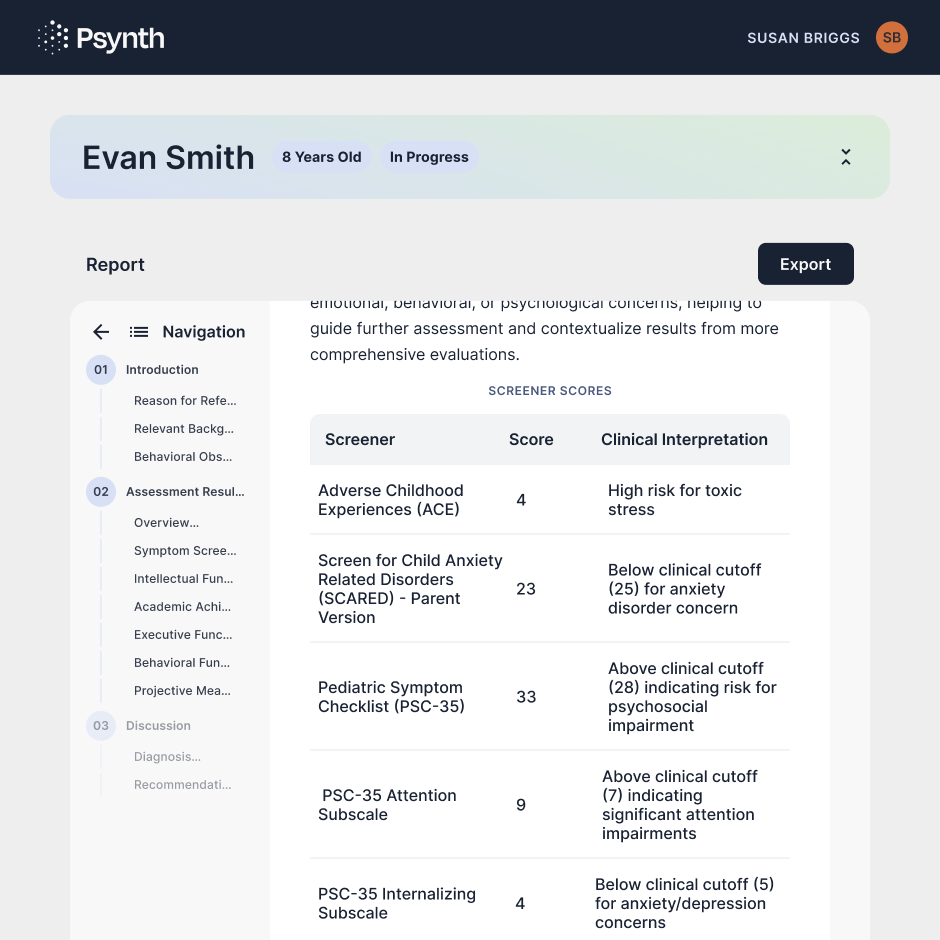
If every clinician in your practice starts from the same section architecture, the same order of operations for a psychoeducational evaluation, the same place where eligibility language for IDEA lives, then your supervisors stop reviewing layout and start reviewing reasoning. Standardizing reports across clinicians is boring infrastructure work (nobody's ever been excited about a template library), and it does more for your quality problem than any amount of feedback on individual drafts, especially once AI report writing group psychology practice is in the mix.
Boring wins here.
What NOT to standardize
The interpretive narrative. Two psychologists looking at the same BASC-3 profile with the same background history should be able to write different reports, because clinical judgment is the product. PAR made this point well in their write-up on AI in psychological report writing, which is worth 10 minutes over at parinc.com. Report writing is clinical reasoning. You've got to know what the constructs mean and pull a pile of data sources together in your head. Software can hold structure and drop numbers in the right places. It can't hold the reasoning.
Psynth handles that split reasonably well for multi-clinician groups. Every clinician's V1 Report uses the same section structure and the same scoring handling, and Clinical Voice settings keep it sounding like the person who wrote it rather than a template with new names dropped in.
Generic boilerplate is the failure mode everyone fears, and it's mostly a workflow problem. If a draft is data-grounded in the actual protocol data, the recommendations track the actual findings. If it's generated from a prompt and a vibe, you get filler, and your reviewers will burn out trying to catch it.
Supervision, Trainees, and the Second Signature in AI Report Writing Group Psychology Practice
Here's where group practices get exposed. A postdoc or practicum student drafting with AI, then a supervisor countersigning, means two layers of review, each assuming the other did the work.
The thing is, you have to make the trainee expectation explicit. They check every score against the protocol before the draft goes to supervision, and they can defend every interpretive statement without pointing at the software. Supervision notes should probably document what changed between draft and final, at least for the first handful of evaluations (and yeah, this is annoying to track). Not forever. Long enough that the habit sticks.
Training checklist for AI report writing
Keep the clinician-in-the-loop framing as your baseline; there's a decent breakdown of it over at psychdraft.com. For trainees, I'd push it harder (unpopular in some training clinics, I know), because the whole point of training is to build the interpretive reasoning that a draft would otherwise just hand to them. A trainee who never sweats through an integration paragraph may never learn to think one.
Supervision documentation requirements
Supervisors reviewing AI report writing group psychology practice output should document:
Pre-review elements checked:
Content review elements:
Post-review sign-off:
Common Pitfalls When Scaling AI Report Writing in Group Psychology Practice
Pitfall 1: Assuming peer review creates accountability
Get a few clinicians reviewing each other's work, and each one figures the other one caught it. Document a single clinician as responsible for final review.
Pitfall 2: Letting speed override depth
If turnaround shrinks and volume climbs but review time stays flat, quality drops. Blame the workflow there. Software didn't decide to skip the review.
Pitfall 3: Mixing approved and unapproved tools
Clinicians default to whatever's fastest or most familiar. An allowlist with regular auditing is the only defense.
Pitfall 4: Inadequate disclosure to clients
Parents, teachers, and referring providers should know when AI was used in the drafting process. How specific that disclosure needs to be is a policy choice, but consistency across clinicians matters.
Pitfall 5: Writing the policy and never checking it
A policy nobody audits is decoration. Pull reports quarterly, at minimum.

Questions Group Practices Keep Asking About AI Report Writing
Is AI-generated report writing in group psychology practice HIPAA-compliant?
Only if the tool is. You need a signed BAA, a documented answer regarding data retention, and evidence such as SOC 2 Type 2 or ISO 27001. Free consumer tool with protocol data pasted in? That's a disclosure, full stop.
Do we have to tell parents or clients that AI was used?
Your board or state may have a view, so check. Past that, it's a practice decision. Pick one position and hold every clinician to it.
Can a supervisor sign a trainee's AI-drafted report?
Yes, under the same supervision rules that already apply. The countersignature means the supervisor reviewed the clinical reasoning, not the software.
Who is liable if an AI-drafted report contains a scoring error?
The signing clinician. Software vendors don't hold a license, and your board won't be asking the vendor questions. This is why score verification in AI report writing group psychology practice is non-negotiable.
Does a group practice AI policy differ from a solo one?
Yes, mostly on logging and tool control. Solo, you know what you used. Across 20 clinicians, you need an allowlist, an audit trail, and one disclosure position; otherwise you're just guessing at your own risk profile.
What should a group practice AI policy actually include?
Approved tools by name, BAA status for each, the line-by-line review list, logging requirements, one disclosure position, and a trainee provision. Six sections, a couple of pages. Longer than that and nobody reads it.
Who owns the AI-drafted report if the clinician leaves the group?
Same answer as any other clinical record: the practice holds the file, the departing clinician's signature stays on it. Worth writing into your employment agreement anyway; most of them predate any of this.
How do we roll out AI report writing across a group psychology practice without chaos?
Pilot it with two or three clinicians on one evaluation type; WISC-V plus WIAT-4 psychoeds are the usual starting point, then write the policy off what you actually learned. Rolling it out to everyone on day one just means you're writing the policy after the fact.
What do we do if a clinician already used an unapproved tool?
Find out what data was involved, document it, and run it through breach analysis as you would any other unauthorized disclosure. Then fix the allowlist gap that let it happen. Punishing the clinician doesn't close the hole.
How many reports should we audit?
Ten to fifteen recent ones is enough to see whether the policy is real or decorative.
Where This Leaves Your Practice on AI Report Writing Group Psychology Practice Governance
Honestly, the sign-off question in the AI report-writing group psychology practice isn't really about AI. It's the documentation integrity question you already had, surfaced by a tool that makes drafting faster and review more important. Practices that write the policy before the tools spread tend to be fine. Practices that learn about their AI usage retroactively, usually through a records request, tend not to be.
Action items for implementing this policy:
Weeks 1-2. Audit current AI tool usage across all clinicians.
Month 1. Build an approved tools allowlist with BAA verification.
Week 6. Draft the sign-off policy covering review, logging, and disclosure.
Week 8. Train every clinician on the new expectations, with documented competency sign-off.
Week 10. Turn on audit trail logging in your EHR or documentation system.
Week 12. Pull 10-15 recent reports and check whether the policy actually held.
Psynth gives every clinician the same draft structure, so your review time in AI report writing and group psychology practice goes toward clinical judgment rather than formatting. If you want to see what that looks like across your team, Psynth's free trial is a low-friction way to run it on a real evaluation before you write the policy around it.
Frequently Asked Questions
Does HIPAA apply to AI tools psychologists use?
Yes. Any tool that processes, stores, or transmits PHI on behalf of a covered entity is subject to HIPAA. That includes AI tools used for documentation, assessment synthesis, or note generation.
Can AI replace a psychologist's clinical judgment?
No. AI can organize information, draft language, and surface patterns, but it cannot take responsibility for diagnosis, risk assessment, treatment decisions, or final report conclusions. The psychologist must review and verify the output and remains accountable for every clinical decision.
Does Psynth's AI store patient data?
No. Psynth uses a zero-retention architecture. Patient data is tokenized during processing and is not stored, cached, or used for model training. Each report operates in an isolated environment.
How do you document a mental health crisis?
Crisis documentation should include a short risk summary describing the level of risk in plain terms, the early warning signs the client can recognize, and the actual safety plan — coping steps, support people, and safe places the client can turn to first. It should also list emergency contacts and hotlines, guidance on when to seek urgent or emergency care, and a follow-up plan describing how and when you'll check in.
How do I start using Psynth?
Start a free trial directly in the Psynth app, then email support@psynth.ai to redeem the AU and NZ pricing offer.
See Psynth work in real time
We’ll demo an end-to-end report writing process and answer any questions along the way. (Yes, it’s so quick, we can get through it all during a single call.)